 How-to
How Do You Find Durable Cat Toys That Last?
Last Updated: November 5, 2026
Quick Summary
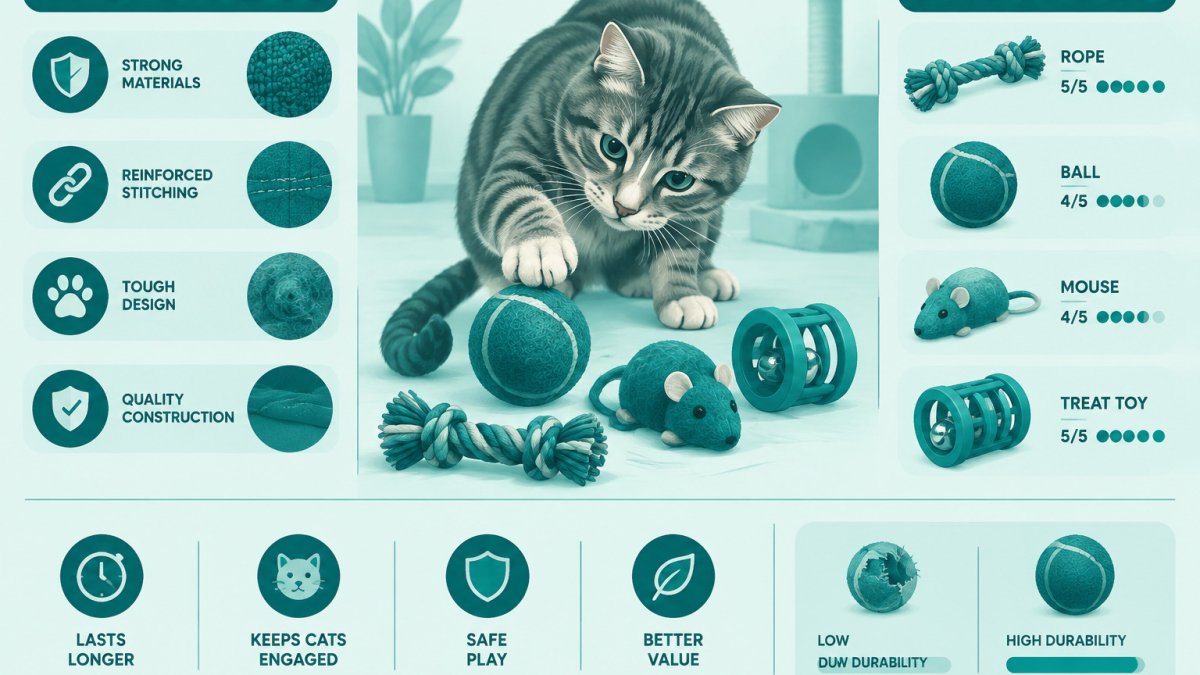
To find durable cat toys, first match the toy to your cat's play style, whether she bats, kicks, chews or carries. Then check the materials, double-stitched seams and attachments, and do a quick tug test before handing it over. Inspect toys weekly and replace any with loose seams, exposed stuffing or frayed strings.
- Divide a toy's price by the weeks it lasts to compare real value.
- Watch your cat for a few days to identify whether she bats, kicks, chews or carries.
- Choose double-stitched seams and one-piece designs with fewer weak points.
- Run a tug, twist, bite and shake test before letting your cat play unsupervised.
- Replace any toy right away if seams loosen, stuffing shows or strings fray.
Table of Contents
- Why Durability Matters More Than Price in a Cat Toy
- Step 1: Match the Toy to Your Cat's Play Style
- Step 2: Check Materials, Seams, and Construction
- Durable Cat Toys for Indoor Cats: What to Prioritize
- Durable Cat Toys for Kittens and Cat Toys for Aggressive Chewers
- How Long Cat Toys Last and When to Replace Them
- Your Next Step: Build a Durable Toy Shortlist for Your Cat
- Frequently Asked Questions
Why Durability Matters More Than Price in a Cat Toy
Cheap cat toys are tempting. For a guide to picking sturdy toys that last, see how to pick durable cat toys. But a toy that falls apart in a day costs more over time than one that lasts for months. The toy your cat loves most is often the one that survives the longest.
Durability matters for two reasons. First, a torn toy can be a choking hazard, since loose stuffing and small pieces are easy to swallow (Small Parts Ban and Choking Hazard Labeling). Second, a toy that lasts keeps your cat's interest longer, because cats get bored with predictable play.
Here is a simple way to think about it:
- Cost per week: Divide the price by how many weeks the toy lasts.
- Safety: Check whether the toy stays intact after rough play.
- Engagement: Note whether your cat still plays with it after a month.
A $10 toy that lasts six months beats a $3 toy that lasts three days. Price alone tells you very little about a toy's real value.
Step 1: Match the Toy to Your Cat's Play Style
Every cat plays differently. To learn which toys are safe when you leave your cat alone, read safe cat toys for unsupervised play. Some cats bat and pounce. Others chew, kick, or carry toys around the house. Matching the toy to the play style is the fastest way to find something that holds up.
Watch your cat for a few days and note what she does most:
- Batters and swats: Choose toys with a firm, tight build that resists claws.
- Kicks and wrestles: Pick toys with reinforced seams and no loose parts.
- Chews and bites: Look for materials made for chewing, not thin fabric or soft plastic.
- Carries toys: Choose lightweight, one-piece toys she can grip easily.
Watch out: A toy designed for gentle batting can split within minutes under a determined chewer. Mismatched play style is the most common reason a toy fails early.
Step 2: Check Materials, Seams, and Construction
Once you know your cat's play style, check how the toy is built. Three things matter most: the outer material, the seams, and whether any parts can come off. This is also where most durability claims fall apart, because a toy labeled "durable" or "indestructible" tells you nothing about how it is actually put together.
Materials to look for:
- Thick, tightly woven fabric instead of thin, stretchy knit
- Hard plastic or dense rubber for chewing toys
- Natural fibers like sisal for scratching surfaces
- One-piece molded rubber or solid plastic for heavy chewers
Seams and stitching:
- Double-stitched seams hold up far better than single lines of thread
- Look for stitching that runs deep into the fabric, not just along the surface
- Reinforced stress points at the ends of wands and the joints of kickers
Attachments:
- Avoid bells, buttons, and eyes that are glued or lightly stitched on
- A one-piece design has fewer weak points than a toy built from many parts
- On wand toys, check that the cord is knotted through a grommet, not just glued into the handle
Material-specific safety risks to weigh:
- Loose fibers and strings: Yarn, ribbon, and long feather strands can be swallowed and cause intestinal damage. Trim loose strands and retire any toy that sheds fibers.
- Swallowed stuffing: Polyester fill is the most common hazard in torn plush toys. A toy that leaks fill should be removed immediately, not repaired and returned.
- Detachable parts: Small bells, plastic eyes, and pom-poms are choking risks. Tug each one before handing the toy over.
- Chewable materials: Thin plastic and soft foam break into pieces under determined chewing. Hard rubber and dense plastic resist puncturing better.
A repeatable at-home durability test: Before you let your cat play unsupervised, run this quick check:
- Tug test: Gently pull each seam, attachment, and cord end. Anything that gives or stretches should be skipped.
- Twist test: Twist the toy as a cat would in a wrestle. Listen for cracking plastic or ripping fabric.
- Bite test: Press a fingernail into the material where a cat would bite. If it dents easily or flakes, it will not survive a chewer.
- Shake test: Shake the toy hard. Any rattle from a loose internal part means it is not safe for unsupervised play.
No toy is truly indestructible. The goal is to find toys that fail slowly and visibly, so you can catch wear before it becomes a hazard. Give the toy a gentle tug at each seam before you buy or hand it over. If you feel any give or see loose threads, skip it.
Use this quick reference to check the materials, seams, and attachments that decide how long a cat toy lasts.
| Check | What to look for | Red flag |
|---|---|---|
| Outer material | Thick, tightly woven fabric or dense rubber | Thin, stretchy knit |
| Seams | Double-stitched, deep into the fabric | Single line of thread |
| Attachments | One-piece design, knotted cord | Glued or lightly stitched bells and eyes |
| Loose fibers | Trimmed, no shedding | Yarn, ribbon, or feather strands pulling loose |
| Stuffing | Fully sealed | Leaking polyester fill |
| Tug test | Seams and parts hold firm | Any give or stretch |
Durable Cat Toys for Indoor Cats: What to Prioritize
Indoor cats need more from their toys because they have fewer outlets for play. You can browse sturdy indoor scratching and resting furniture with a solid frame that does not tip. A sturdy toy gets used more often, so durability counts for even more.
For most indoor cats, prioritize:
- Interactive wand toys with a strong, tightly attached feather or fabric end
- Puzzle feeders made from thick plastic that resists cracking
- Scratchers and resting furniture with a solid frame that does not tip
When considering any cat furniture, use the same checks from Step 2: solid base, tight joints, and scratching surfaces that stay firm.
If you are unsure where to start, our sturdy cat toys collection covers options for active indoor play.
Durable Cat Toys for Kittens and Cat Toys for Aggressive Chewers
Kittens and aggressive chewers test toys in very different ways, so each needs its own approach.
For kittens: Kittens play hard and learn by biting and grabbing. Choose toys with no small parts that can come loose and be swallowed. Soft, one-piece toys with strong seams work well.
For aggressive chewers: Some cats chew through toys in minutes. Look for hard rubber or dense plastic designed for chewing. Avoid anything with strings or fabric pieces that can be pulled apart and swallowed.
If your cat is a heavy chewer, supervise play and remove any toy once it shows signs of wear. Chewed-through toys can cause blockages.
For a dedicated list of toys built for heavy chewing, see our guide to durable cat toys for aggressive chewers.
How Long Cat Toys Last and When to Replace Them
No toy lasts forever. The goal is to know when wear becomes a safety problem, and to judge a toy by how long it stays safe rather than by what it cost on the shelf.
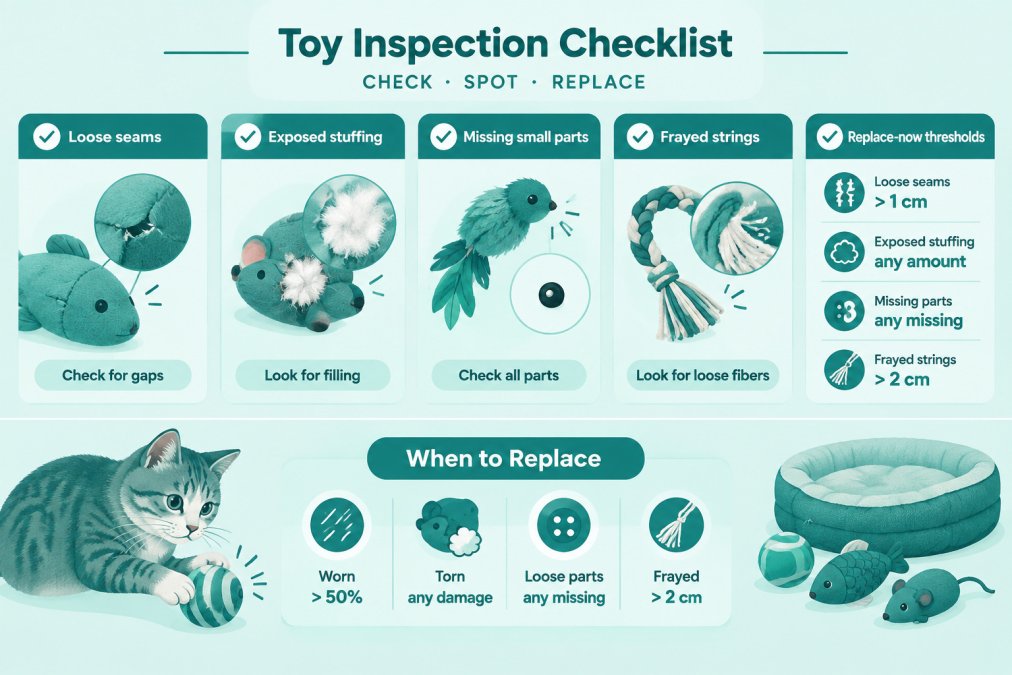
Expected wear by toy type:
- Wand toys: The wand itself often outlasts the attachment. Feather and fabric ends typically show wear first, so plan on replacing the lure while keeping the wand.
- Kickers and plush toys: Seams and stuffing are the failure points. A well-stitched kicker may hold up for months; a thin one can split in a single session.
- Balls and track toys: Hard plastic balls usually last a long time, but track toys can crack at the joints under repeated pouncing.
- Puzzle feeders: Thick plastic resists cracking, but thin lids and sliding parts wear out faster than the body.
- Scratchers: Sisal surfaces fray and flatten with use. Replace when the surface no longer offers resistance.
Cost per month, not sticker price: A toy's real value is its price divided by the months it stays safe. A toy that costs a few dollars and fails in a week is more expensive per month than a sturdier toy that lasts a season. Track two or three toys over a few weeks and note which ones still look intact. That shortlist is worth more than any "durable" label.
Replace a toy right away if you see:
- Loose or missing seams
- Exposed stuffing or filling
- Small pieces that have come off or could come off
- Frayed strings, ribbons, or feathers that are pulling loose
- Cracks in hard plastic
- A toy that feels flatter or lighter than when it was new
Cleaning that extends usable life:
- Spot-clean fabric toys with a damp cloth and mild soap, then air-dry fully.
- Avoid harsh chemicals and hot dryers, which can weaken fibers and glue.
- Wipe hard plastic and rubber toys with a damp cloth and let them dry before storage.
- Store toys in a dry bin rather than leaving them on the floor where they collect grit and hair.
Check toys once a week. A quick look and tug takes less than a minute, and it can prevent injuries. Most sturdy toys last several months with regular play, while cheap toys often fail within days.
Watch out: A toy that looks fine on the outside can still have a split seam inside. If the stuffing feels loose or the toy looks flatter than before, retire it. Shipping from the USA means replacement toys can arrive quickly.
Your Next Step: Build a Durable Toy Shortlist for Your Cat
Finding durable cat toys comes down to a few habits. Watch how your cat plays, check materials and seams, and inspect toys regularly. Those three steps will save you money and keep your cat safe.
Start with two or three toys that match your cat's play style. Test them for a few weeks, and note which ones hold up. Over time, you will build a shortlist of toys your cat loves and that last.
Browse our full range of cat toys and furniture at Knead and Nuzzle, and find options that match your cat's play style and your home.
Frequently Asked Questions
How can you tell if a cat toy is durable?
Look at construction before you buy. Seams should be double-stitched and tight, with no loose threads. Materials should be thick and tightly woven, and the toy should be one piece or have parts that cannot be pulled off easily. Check that eyes, bells, and other small parts are secured. Hold the toy and pull firmly on stress points. If anything gives, your cat will likely find that weak spot too.
How often should you replace a damaged cat toy?
Replace a toy as soon as it has exposed stuffing, loose seams, missing or loose small parts, or frayed strings your cat could swallow. Small parts and string pieces are the most common hazards, so do not wait for a toy to fall apart completely. Inspect toys weekly if your cat plays hard, and clean them regularly so wear is easier to spot. A toy that shows damage should be removed from play right away.
Are any cat toys truly indestructible?
No cat toy is fully indestructible, especially for a cat that chews or pulls. Durability depends on the cat's play style, age, and habits. Well-built toys with tight seams, thick materials, and one-piece designs hold up longer, but all toys need regular inspection. Focus on toys built to last and replace them when wear appears.
What are the safest cat toys for indoor cats?
Choose toys with no small detachable parts, no loose strings, and seams that stay closed under pressure. Interactive toys used under supervision, such as wand toys and puzzle feeders, add enrichment while reducing unsupervised chewing. Store toys out of reach when you are not playing with your cat. Browse Knead and Nuzzle's toy selection to find options suited to indoor play.