 How-to
Why Cats Scratch Furniture and How to Redirect Them
Last Updated: November 19, 2026
Quick Summary
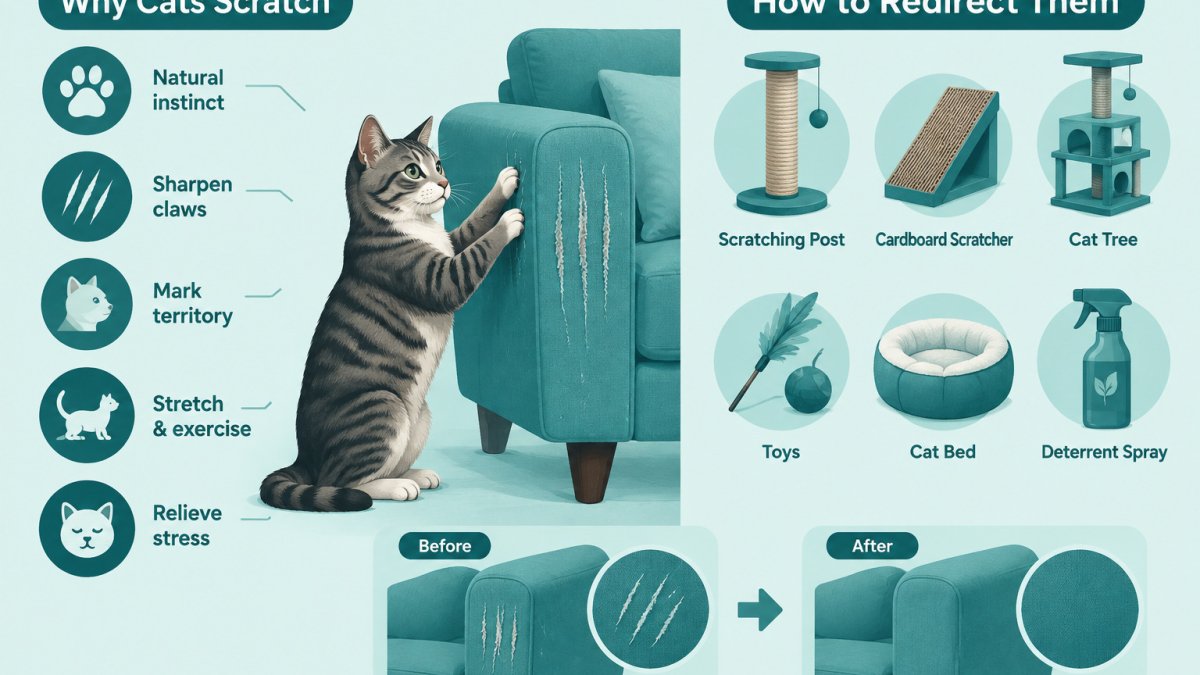
Cats scratch furniture to remove old claw sheaths, mark territory with scent and sight, and stretch, and they often pick sofas because the texture and height feel right. To redirect them, place a scratcher of matching angle and height beside the target, reward every use, and cover the furniture while you work through the stages. Why cats scratch furniture and how to redirect them comes down to matching the outlet to what the cat wants.
- Cats scratch to remove frayed outer claw layers and keep claws sharp.
- Watch each scratch for surface, angle, and height before choosing a scratcher.
- Match vertical scratchers to downward raking and horizontal pads to pulling motions.
- Make sure the post is tall enough for the cat to stretch fully while standing.
- If no change appears after six weeks, adjust placement, height, stability, or material.
Table of Contents
- Why Cats Scratch Furniture in the First Place
- Why Do Cats Scratch Furniture and Carpets, Not Just Posts?
- Do All Cats Scratch Furniture? What Drives the Difference
- How to Choose a Scratcher Your Cat Will Actually Use
- Step-by-Step: How to Redirect Your Cat From the Sofa to a Scratcher
- Choosing a Spray or Deterrent Safely, and What to Avoid
- Your Next Step: Set Up a Scratching Zone This Week
- Frequently Asked Questions
Why Cats Scratch Furniture in the First Place
Scratching is a normal, healthy behavior for cats, and understanding why cats scratch furniture and how to redirect them starts with seeing it as a sign that your cat has needs that deserve a good outlet.
Understanding the reason behind the scratching makes it much easier to fix, and knowing why cats scratch furniture and how to redirect them gives you a clear path forward.
Claw maintenance and removing frayed outer layers
A cat's claws grow in layers. The outer sheath wears down and sheds as the cat scratches, revealing sharp new claws underneath. Scratching helps pull off those old, frayed layers. Cats often seek out surfaces that grip well, such as upholstery, carpet, or wood, because these surfaces give the claw enough resistance to shed the outer layer.
- Cats scratch to remove old claw sheaths
- Rough, firm textures work best for this
- Regular scratching keeps claws healthy and sharp
Scent and visual marking of territory
Cats have scent glands in their paws. When a cat scratches, it leaves a visual mark and a scent mark behind (Feline Behavior Problems: Destructive Behavior). Scratching is one of the main ways cats say, "This space is mine." Your furniture carries your scent, which can make it feel especially rewarding to your cat as a marking target.
Why Do Cats Scratch Furniture and Carpets, Not Just Posts?
Many cat owners are surprised when their cat ignores an expensive scratching post and goes straight for the couch.
Furniture and carpet often feel more satisfying to scratch than a post made from the wrong material.
Watch out: If a cat has learned that a certain piece of furniture is its favorite scratching spot, the habit can become strong quickly.
Do All Cats Scratch Furniture? What Drives the Difference
Not every cat scratches furniture, but most cats scratch. Some cats scratch more than others because of personality, age, energy level, and how much they have to scratch with during the day.
- Young and high-energy cats often scratch more
- Indoor cats with few outlets may turn to furniture
- Cats in multi-cat homes may scratch more to mark shared space
Knowing your cat's habits helps you choose the right scratcher and the right place for it.
How to Choose a Scratcher Your Cat Will Actually Use
Most guides tell you to buy a sturdy post. That is not enough. The scratcher that works is the one that matches how your cat already scratches, so start by observing rather than shopping.
Step 1: Watch where and how your cat scratches
Spend a few days noting three things about every scratching episode: the surface, the angle, and the height.
- Angle. Does your cat rake downward on a vertical surface like a sofa arm or door frame, or pull toward itself on a flat surface like carpet or a doormat? Vertical scratchers suit the first group; flat pads and inclined ramps suit the second.
- Height. Watch how far your cat extends. A cat that stretches to full length on a chair back needs a post tall enough to reach that point while standing on its hind legs. A cat that scratches low to the ground is often happier with a horizontal pad.
- Surface. Note whether the target is loose-weave fabric, tight upholstery, carpet, wood, or cardboard. That tells you which material to try first.
Step 2: Match the scratcher to what you observed
| What you saw | Best first choice | Why |
|---|---|---|
| Downward raking on a tall surface | Vertical sisal post, at least as tall as the cat at full stretch | Lets the cat extend and pull without hitting the floor |
| Downward raking but low to the ground | Short vertical post or inclined scratcher | Matches the angle without demanding a big stretch |
| Pulling toward itself on carpet | Flat corrugated cardboard pad or carpet pad | Same motion, same resistance |
| Scratching on wood or tight fabric | Sisal rope or sisal fabric | Firm grip that sheds the outer claw sheath |
| Scratching on loose upholstery | Carpet or cardboard | Similar give and texture |
Step 3: Check stability and size before you buy
A scratcher that rocks or slides will be abandoned, no matter how good the material is. Look for a wide base, a weighted bottom, or a design you can brace against a wall.
- The post should be tall enough for a full stretch with the front paws overhead
- The base should be wide enough that the post does not tip when the cat pulls
- The material should be replaceable or reversible if your cat is a heavy scratcher
If your cat is large or very active, choose a heavier build. Our durable cat scratchers for large cats are sized for full-stretch scratching and daily wear. In a smaller home, durable cat scratchers for apartments keep the footprint tight without sacrificing stability.
Step 4: Offer two options, not five
A common mistake is filling the room with scratchers at once. Start with two: one vertical and one horizontal, placed where your cat already scratches. Watch which one gets used, then add a second of the winning type in another room.
Watch out: A scratcher made from the wrong material can sit untouched for months while the cat keeps using the sofa.
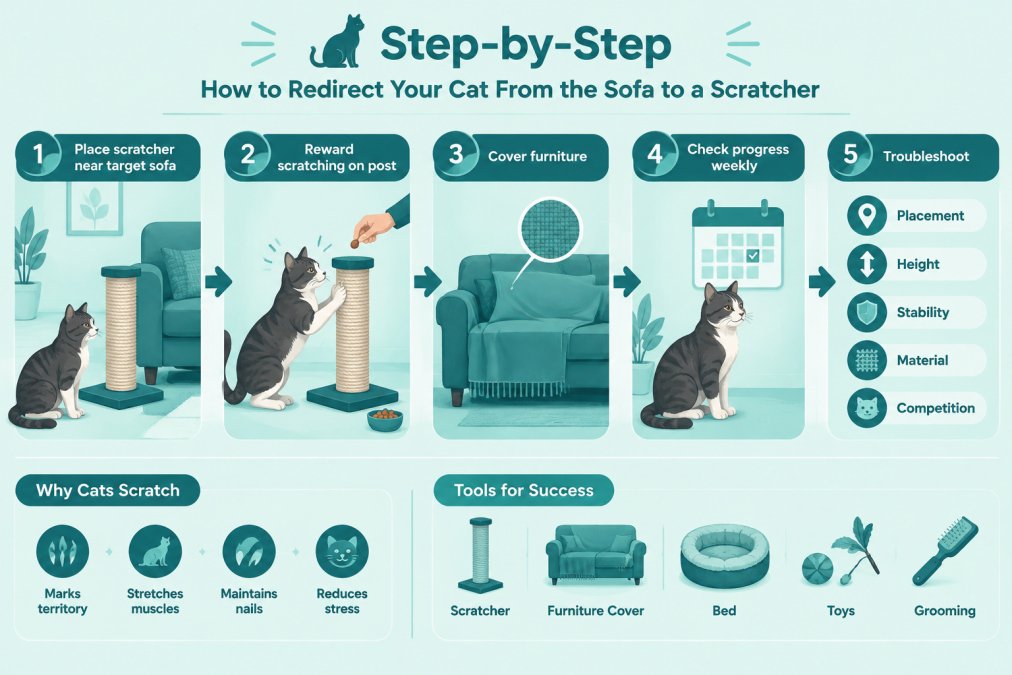
Step-by-Step: How to Redirect Your Cat From the Sofa to a Scratcher
Redirection works best as a staged plan with checkpoints, not a one-time setup. Give each stage about two weeks before deciding whether to adjust, and change only one variable at a time so you can tell what worked.
Stage 1: Place and observe (weeks 1-2)
- Put a scratcher directly beside the target furniture. Place it so your cat can scratch it without stepping away from the sofa.
- Match the scratcher to the observed behavior. Use the selection guide above: vertical for downward raking, horizontal for pulling toward the body.
- Do not block the sofa yet. You want to see whether the cat chooses the scratcher on its own.
Checkpoint: Is the scratcher being used at all? If yes, move to Stage 2. If not, change the material or orientation before adding anything else.
Stage 2: Reward and reinforce (weeks 2-4)
- Reward every use you see. A treat, praise, or a quick play session right after scratching tells the cat this is the better option.
- Reward timing matters. Deliver the reward within a second or two of the scratch, while the cat is still at the scratcher.
- Do not reward the cat for scratching the sofa by picking it up or giving it attention. Redirect calmly to the scratcher instead.
Checkpoint: Is the cat choosing the scratcher more often than the sofa? If yes, move to Stage 3. If not, try a second scratcher of a different type nearby.
Stage 3: Protect the furniture (weeks 4-6)
- Cover or block the target area. A slipcover, a throw, or a temporary barrier makes the sofa less rewarding without punishing the cat.
- Keep the scratcher in place. Do not move it away once the cat is using it.
- Add a second scratcher in another room the cat uses often, so the habit generalizes.
Checkpoint: Are new scratch marks on the furniture dropping? If yes, keep the setup stable for another month.
Stage 4: Troubleshoot if redirection stalls
If the cat is still targeting the sofa after six weeks, work through these in order:
- Placement. Move the scratcher closer to the exact spot the cat scratches, not just the same room.
- Height. Check that the post allows a full stretch. A too-short post is one of the most common reasons cats abandon a scratcher.
- Stability. Brace a wobbly post against a wall or replace it with a heavier base.
How to measure progress
Track three simple indicators weekly:
- Scratcher use: how often you see the cat on the scratcher
- New damage: fresh marks or fraying on the furniture
- Consistency: whether the cat uses the scratcher at the same times each day
A downward trend in new damage over four to six weeks is the signal that the plan is working. If scratching suddenly intensifies, or the cat shows signs of pain, stress, or compulsive behavior, talk with your veterinarian or a behavior professional.
If you are adding new furniture as part of the setup, go slowly. Our guide on how to introduce new cat furniture walks through a gradual approach. A cardboard option can also be an easy first step: our cardboard cat scratching house gives your cat a low-cost place to scratch while you work through the stages.
Choosing a Spray or Deterrent Safely, and What to Avoid
Deterrents can help, but use them with care. Harsh sprays or punishment can stress your cat and damage the bond you share.
A boundary mat is one option. The Petsafe Cat Scatmat indoor boundary training mat creates a clear zone that discourages your cat from jumping onto a spot you want to protect, without spraying anything at your cat.
Never use a product that your cat could chew, lick, or inhale in large amounts. Persistent scratching changes can sometimes signal a behavior issue that a professional can help you address (Feline Behavior Problems: Destructive Behavior).
Your Next Step: Set Up a Scratching Zone This Week
Start with one scratcher, one target piece of furniture, and one reward plan. Place the scratcher where your cat already scratches, and reward it every time your cat uses it. Shop our range of cat scratchers and furniture to find an option that fits your cat's size, energy, and home. Get started today and give your cat a scratching spot it will love.
Frequently Asked Questions
Why do cats suddenly start scratching furniture?
A sudden change often has a clear trigger. Cats scratch to maintain their claws and to mark territory with scent glands in their paws, so a new piece of furniture, a new cat or visitor in the home, or a stressful change can increase scratching. Check whether the scratching targets a spot near a window, a doorway or a sleeping area, since cats often mark places they pass or rest. If the behavior is new and intense, or your cat also seems unwell or is avoiding the litter box, schedule a visit with your veterinarian to rule out pain or medical causes before changing the training approach.
Do all cats scratch furniture?
Most cats scratch, because scratching is a normal feline behavior, but not every cat chooses your sofa. Some cats prefer vertical posts, others prefer horizontal pads, and some scratch mainly carpet or rugs. Whether a cat targets furniture depends on the texture it likes, how stable the available scratchers are, and whether a suitable surface is placed where the cat spends time. Providing a variety of surfaces early makes it easier to see which one your cat prefers.
What smell do cats hate to stop scratching furniture?
Many owners find that cats tend to avoid citrus scents, but scent-based deterrents work inconsistently and should never be the only strategy. Some cats ignore them entirely. Avoid essential oils in general, because several are toxic to cats and can cause harm if your cat grooms itself after contact. A safer approach is to cover furniture with a textured protector, keep the area less appealing with physical barriers, and offer a preferred scratcher nearby. If you use any spray, check that the product is labeled safe for cats and test a small area first.
How do I train my cat to use a scratching post?
Start by placing the post in the spot where your cat already scratches, since location matters as much as the post itself. Make the post stable so it does not wobble, because a shaky scratcher teaches cats to avoid it. Rub a little catnip or use a favorite toy near the post, and reward your cat with treats or play immediately after it scratches the post. Keep sessions short and consistent. If your cat ignores the post for several weeks, try a different material or orientation, such as switching from vertical to horizontal, before concluding that the approach will not work.