 blog
blog
Durable Cat Scratchers for Apartments: A 2026 Guide
Table of Contents
- Why Durable Cat Scratchers Matter in Apartments
- Best Materials for Cat Scratchers That Last
- Compact Designs That Fit Small Spaces
- Cat Scratching Post Placement Tips for Apartment Living
- How to Train a Cat to Use a Scratching Post
- Durability and Longevity: What to Expect
- Noise Control and Floor Protection
- Frequently Asked Questions
Last Updated: October 7, 2026
Why Durable Cat Scratchers Matter in Apartments
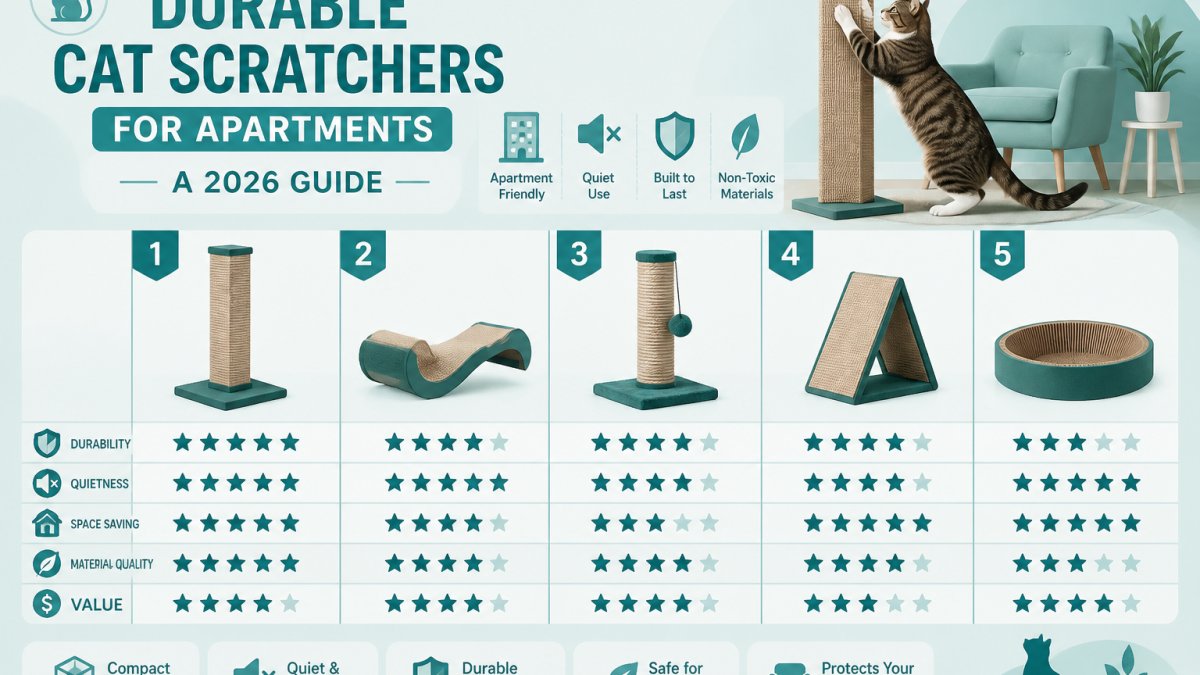
Scratching is essential for claw health, stress relief, and marking territory, so the challenge is finding durable cat scratchers for apartments that withstand daily use without damaging walls, floors, or your lease.
At Knead and Nuzzle, we understand apartment constraints: space is limited, noise travels, and landlords scrutinize damage.
Below, we'll show you how to choose durable cat scratchers for apartments that your cat will actually use.
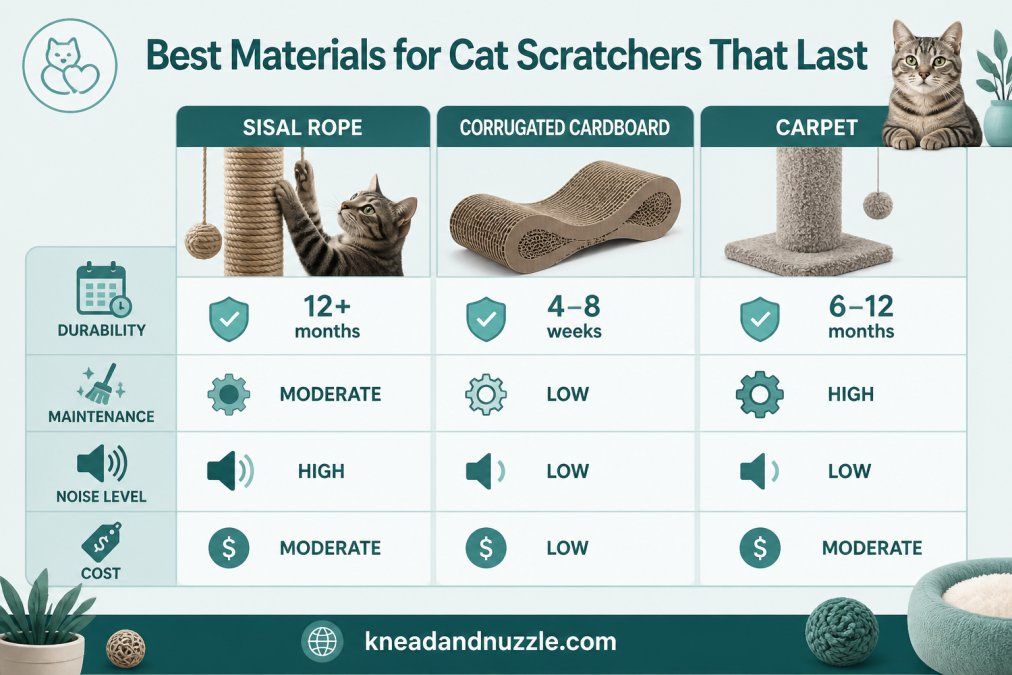
Best Materials for Cat Scratchers That Last
The material determines how long your post lasts and how much maintenance it needs.
Sisal Rope and Natural Fibers
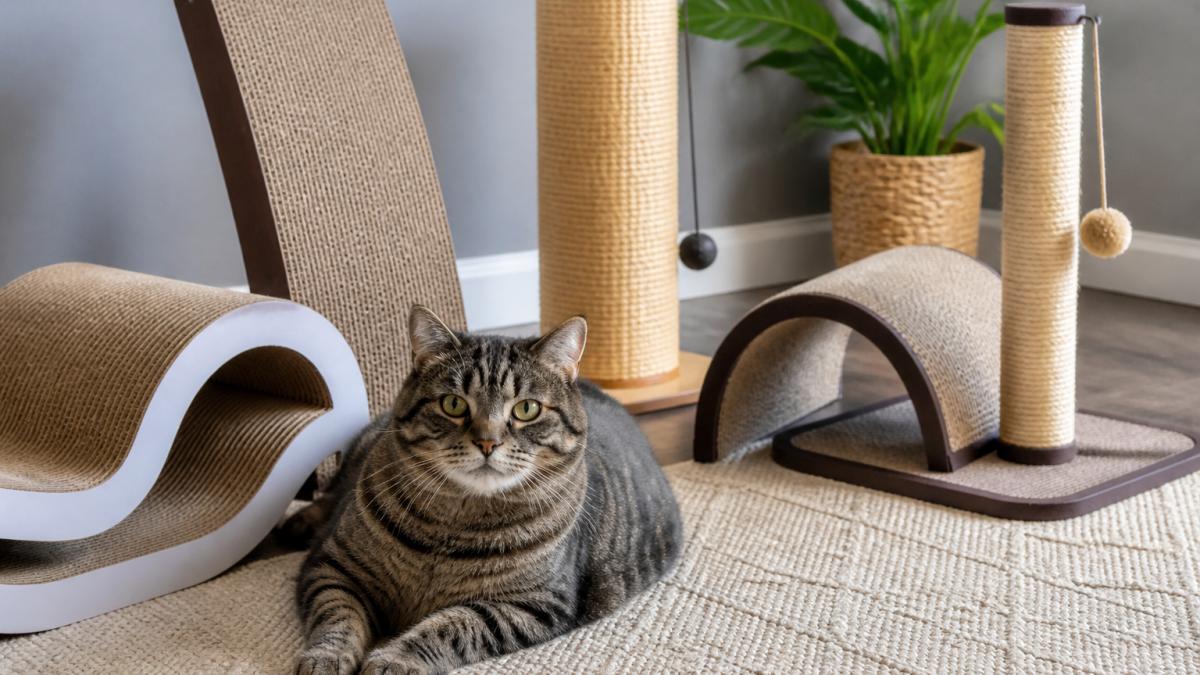
Sisal rope is the gold standard for cat scratchers. Cats love the texture, and when wrapped tightly around a post, it resists shredding far longer than alternatives.
Sisal holds up because its fibers are dense and tightly woven, resisting visible wear for months.
The trade-off: sisal needs occasional vacuuming and isn't silent, aggressive scratching carries through walls.
Jute and manila perform similarly, though sisal outlasts both, the most durable choice for heavy scratchers.
Corrugated Cardboard and Recycled Materials
Cardboard scratchers are affordable, eco-friendly, and cats love shredding them, but they wear out fast. A heavy scratcher can destroy one in 4-8 weeks, meaning frequent replacements and more waste. Recycled cardboard is lightweight and easy to move or store, which matters if you rent and expect to relocate. Cardboard works best as a supplement to a more durable option, not as primary furniture.
Carpet and Plush Surfaces
Carpet-covered scratchers feel soft and appeal to some cats, and they're quieter than sisal, useful in thin-walled apartments. But carpet wears unevenly and mats quickly, and once matted, cats lose interest. It also needs vacuuming, shows stains, and traps dust and allergens more than sisal or cardboard.
Compact Designs That Fit Small Spaces
In an apartment, every square foot counts. Your scratching post must deliver function without consuming floor space.
Vertical Scratchers vs. Horizontal Options
Vertical scratchers maximize floor space efficiency: a tall, narrow post occupies roughly 2-3 square feet while offering multiple scratching surfaces and climbing opportunities. Horizontal scratchers, low-profile pads or boards, suit cats that scratch at ground level and fit under furniture or in corners where vertical posts won't. For small apartments, vertical wins: a 6-foot post takes less floor space than a horizontal lounger pad.
Foldable and Space-Saving Solutions
Some posts fold flat for storage or moving, appealing to renters who relocate, though foldable designs trade stability for portability and may wobble under a large or aggressive scratcher. Wall-mounted scratchers eliminate floor footprint entirely but require landlord approval or patch-and-paint work at move-out, ideal for long-term residents, less practical for short leases. For maximum space efficiency, combine a compact vertical scratcher with a wall-mounted option to give your cat multiple scratching zones without using floor space.
Cat Scratching Post Placement Tips for Apartment Living
Placement determines whether your cat uses the post or ignores it.
Cats scratch near areas they spend time, so place your post where your cat sleeps, eats, or watches windows. If your cat scratches the sofa, place a post directly beside or in front of it, redirection works best when the alternative is immediately available. Proximity to existing scratching damage matters more than high-traffic zones.
How to Train a Cat to Use a Scratching Post
Most cats instinctively use scratching posts, but some need encouragement. Start by placing the post near existing scratching damage, since cats gravitate toward familiar scratching spots. Catnip and attractants accelerate adoption, most cats respond within days, and the scent of their own claws reinforces the behavior. Reward immediate use with treats or play, and redirect unwanted scratching immediately: gently interrupt and guide your cat to the post.
Durability and Longevity: What to Expect
Most roundups say a sisal post lasts "12 to 24 months" and stop there. That number is nearly useless, because a 6-foot post wrapped in 3/16-inch sisal and a 2-foot post wrapped in 1/8-inch sisal are not the same product. What actually determines survival in an apartment is a short list of measurable variables.
The variables that actually predict wear
- Sisal diameter and wrap tension. Thicker rope (3/16 inch and up) and tight, gap-free wrapping resist shredding far longer than thin, loose rope, which lets claws pull whole strands free.
- Attachment method. Staples at top and bottom only let the wrap migrate and loosen; glue plus staples or a continuous anchored wrap holds shape.
- Base weight and footprint. A wide, heavy base prevents rocking, which loosens joints and accelerates fraying.
How to run your own wear test
A simple 30-day check tells you more than any spec sheet:
- Week 1: Photograph the post from the same angle and distance. Press a fingernail into the rope, it should feel firm, not spongy.
- Week 2: Push the top sideways with two fingers. Movement beyond a slight flex means the base or joint is loosening.
- Week 4: Re-photograph and compare. Look for exposed core and loose strands hanging more than half an inch.
- Ongoing: Vacuum loose fibers weekly; fibers piling at the base signal the wrap is breaking down.
A post showing exposed core within 30 days of normal use won't make it a year, regardless of the listing's claims.
Reading wear patterns instead of guessing
Different failure modes tell you different things:
- Fraying in one narrow band means your cat scratches in one spot; rotating the post a quarter turn every few weeks spreads the wear.
- Fraying at the top and bottom only points to a loose, sliding wrap, not heavy scratching.
- A matted, flattened carpet surface means most cats will stop using it, and recovery usually isn't worth the effort.
Replacement parts versus full replacement
The clearest durability advantage of a rope-wrapped post is that the rope is a wear item and the frame is not. If the frame is solid and the base stable, replacing the wrap restores it to near-new condition.
Cardboard and carpet don't offer this: once a pad is shredded through or carpet mats, it's done. Rope posts are repairable, and repairable furniture is what lasts in a small apartment.
Noise Control and Floor Protection
This matters most when you share a wall, floor, or ceiling. Scratching noise is three separate problems needing three separate fixes.
Problem 1: The sound of claws on the surface
Sisal rope is loud. Claws dragging across tight fiber carry through drywall and floor-ceiling assemblies in short, repetitive bursts that neighbors notice more than steady background noise.
What reduces it:
- Surface choice. Carpet and cardboard are noticeably quieter than sisal, cutting the sharpest part of the sound.
- Post height and angle. A tall vertical post allows a full upward stretch and a longer, smoother stroke; a short post forces a choppy, repetitive one.
- Placement relative to shared walls. Move the post off shared walls onto an interior wall or hallway, even a few feet and one wall of separation helps.
Problem 2: Vibration transfer through the floor
This is the one people miss. A post directly on a hard floor transmits scratching vibration into the slab and the unit below, you may barely hear it while your downstairs neighbor hears steady thumping.
How to break the transfer:
- Decouple the post from the floor. A dense rubber mat or thick felt pad under the base absorbs vibration; thin adhesive pads do little, you want real thickness and mass.
- Add mass to the base. A heavier base moves less, meaning less vibration. A sandbag or weighted disc inside a hollow base helps.
- Avoid hard-floor corners. Corners on hard floors amplify vibration through two adjoining surfaces; a rug or carpet remnant helps.
Problem 3: Sliding and tipping
A post that slides during scratching is both a noise and safety problem, the most common complaint about lightweight apartment scratchers.
- Check the base-to-floor contact. If the base is smaller than the post is tall, it's prone to tipping. The base footprint should be at least a third of the post's height.
- Use a non-slip layer, not just a pad. Rubber shelf liner or a grippy mat stops sliding far better than felt, which lets furniture slide.
- Anchor without drilling. Tension-mounted or furniture-anchored options exist, and a post wedged between a wall and heavy furniture is more stable than a free-standing one.
Protecting the floor and walls without losing your deposit
Floor and wall damage is the other half of this problem, and it's preventable:
- Under the base: use thick pads on all contact points. On hardwood, check monthly, grit trapped under a pad acts like sandpaper.
- Around the post: keep it at least 12 inches from walls so a full-stretch scratch doesn't hit drywall. Removable corner guards come off cleanly at move-out.
- On the wall behind: removable low-tack film or a cardboard guard catches stray claw marks without residue.
- On carpet: a post left in one spot leaves a compressed ring; moving it a few inches monthly prevents a permanent dent.
Frequently Asked Questions
What is the most durable material for a cat scratching post?
Sisal rope and natural fibers rank highest for durability, resisting shredding through months of regular use. Corrugated cardboard offers excellent value but requires more frequent replacement. For apartment living, sisal provides the best balance of longevity and performance. Your choice depends on your budget and how intensively your cat scratches. We ship all materials from the USA, so replacements arrive quickly when needed.
How do I keep my cat from scratching furniture in a small apartment?
Place a durable cat scratcher near furniture your cat targets, then redirect scratching behavior to it using catnip or toys. Vertical scratchers near walls protect sofa edges, while horizontal options work well in corners. Consistency matters more than placement alone, reward your cat when they use the scratcher. A sturdy, stable post that doesn't tip prevents frustration and encourages regular use in tight spaces.
Are vertical or horizontal scratchers better for small apartments?
Vertical scratchers maximize floor space by using wall height, ideal for studios and one-bedroom units under 20 inches wide. Horizontal options work better if your cat prefers stretching flat or if you have limited wall space. Many cats use both types, so consider your apartment layout and your cat's scratching style. Multi-level designs combine both angles in a compact footprint.
How often should you replace a cat scratching post?
High-quality sisal posts last 6-12 months with regular use; cardboard replacements may need changing every 2-3 months. Inspect for loose fibers, deep gouges, or instability weekly. A worn post loses its appeal and won't protect your furniture. Replacing worn sections rather than entire posts saves money long-term. Durable cat scratchers designed for apartments reduce replacement frequency significantly.