 how-to
How to Introduce New Cat Furniture: A Step-by-Step Guide
Table of Contents
- Why Cats Need Time to Adjust to New Furniture
- How to Introduce New Cat Furniture: The Basics
- Best Place to Put a Cat Tree for Maximum Acceptance
- How to Get a Cat to Use a Cat Tree: Proven Techniques
- Cat Scratching Post Introduction: Making It Irresistible
- How Long Does It Take a Cat to Adjust to New Furniture
- Troubleshooting: What to Do If Your Cat Avoids the Furniture
- Multi-Cat Households: Managing Access and Reducing Stress
- Frequently Asked Questions
Last Updated: October 18, 2026
Why Cats Need Time to Adjust to New Furniture
Cats are creatures of habit. They like their world predictable and safe. When you bring new cat furniture into their space, it disrupts that comfort zone.
This isn't about stubbornness. It's about how cats process their environment. They rely on scent and familiarity to feel secure. New furniture smells foreign. It looks unfamiliar. Your cat's first instinct is often caution, not curiosity.
At Knead and Nuzzle, we help cat owners understand this adjustment period. Rushing the process leads to rejection. The difference between a cat tree your cat ignores and one they love often comes down to how you introduce it.
Some cats warm up in days. Others take weeks. Multi-cat households add another layer of complexity. But the core principle stays the same: let your cat set the pace.
How to Introduce New Cat Furniture: The Basics
Introducing new cat furniture follows a straightforward sequence. Each step builds on the last. Skip a step, and your cat may resist the whole piece.
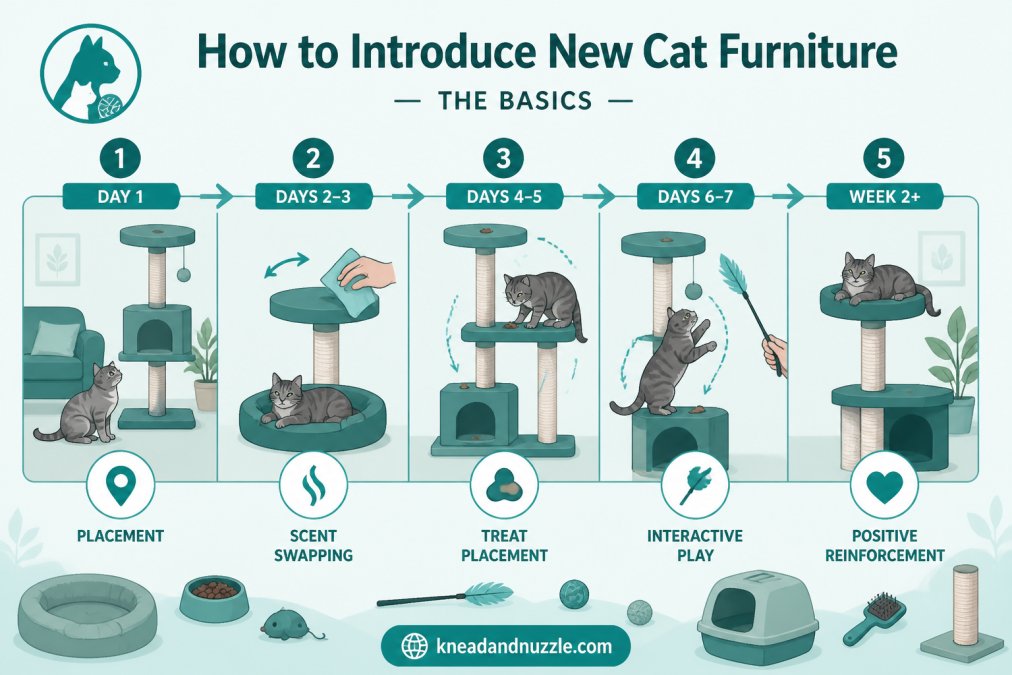
Step 1: Choose the Right Placement for Your New Furniture
Location matters more than most people realize. A cat tree in the wrong spot sits unused. The same tree in the right spot becomes your cat's favorite perch.
Place new furniture in a familiar area where your cat already spends time. Cats feel most confident in spaces they know. A quiet corner of the living room beats a high-traffic hallway. Near a window is ideal, cats love watching the outside world.
Avoid placing furniture in stressful locations. Don't put it near a loud appliance. Don't position it where your cat feels trapped or cornered. Your cat should have an easy escape route if they feel nervous.
Consider vertical space. Cats love height because it makes them feel safe. A cat tree near a wall gives your cat a sense of security. They can survey their territory from above while staying protected.
Step 2: Let Your Cat Investigate at Their Own Pace
Once you've positioned the furniture, step back. Your cat needs to approach it on their own terms.
Don't force your cat toward the furniture. Don't pick them up and place them on it. These actions create negative associations. Your cat learns the furniture is something to avoid, not enjoy.
Instead, sit nearby and ignore the furniture. Let your cat's natural curiosity take over. They'll sniff it. They'll circle it. They'll test it with a paw. This investigation phase is crucial.
Watch your cat's body language. Relaxed ears and a loose tail mean they're comfortable exploring. Flattened ears or a tucked tail signal fear. If your cat seems scared, give them more space and time.
Step 3: Use Familiar Scents to Build Comfort
Scent is your secret weapon. Cats identify their territory through smell. Familiar scents make new things feel less threatening.
Rub a cloth on your cat's face or body. Then rub that same cloth on the new furniture. Your cat's scent glands are concentrated around their cheeks and chin. When you transfer their scent to the furniture, it becomes part of their territory.
Another approach: place your worn clothing on or near the furniture. Your scent is familiar to your cat. It signals safety. Your cat will investigate the furniture more readily when it smells like you.
Catnip or silvervine can help, but use them sparingly. Some cats respond strongly. Others don't. If your cat loves catnip, sprinkle a little on the furniture to encourage exploration.
Step 4: Make the Furniture Appealing with Treats and Food
Food is motivation. Treats create positive associations.
Place small treats on different levels of the furniture. Start low. Gradually place treats higher as your cat becomes comfortable. Your cat learns that the furniture leads to rewards.
You can also feed your cat near the furniture. Not on it initially, just nearby. Over time, move the food bowl closer. Eventually, place it on the furniture itself. Mealtime becomes furniture time.
Be consistent with treat placement. Your cat will start seeking out the furniture because good things happen there.
Step 5: Encourage Exploration Through Interactive Play
Play is bonding. It's also a way to guide your cat toward the furniture.
Use a wand toy or feather toy to play near the furniture. Drag the toy across the surface. Move it up and down the levels. Your cat will chase, and in doing so, they'll explore the furniture naturally.
Keep play sessions short, 5 to 10 minutes. Multiple short sessions work better than one long one. Your cat stays engaged and doesn't get overwhelmed.
As your cat becomes comfortable, move the toy higher on the furniture. Your cat will follow, climbing and investigating without pressure.
Best Place to Put a Cat Tree for Maximum Acceptance
The location of your cat tree determines whether it gets used or ignored. Strategic placement wins acceptance.
Windows are ideal. Cats love watching birds, squirrels, and outdoor activity. A cat tree by a window combines safety with entertainment.
Corner placement works well too. Cats feel secure with walls on two sides. They can't be surprised from behind. A corner near a window is the gold standard.
Avoid placing cat trees in isolated rooms. If your cat spends most of their time in the living room, put the tree there.
High-traffic areas can work if your cat is social. Some cats like being near family activity. Others prefer quiet spots. Know your cat's personality.
Stability matters for placement success. Make sure the furniture won't tip or wobble. A wobbly cat tree creates fear, not comfort.
How to Get a Cat to Use a Cat Tree: Proven Techniques
Getting your cat to actually use the tree requires strategy beyond placement and scent.
Make the tree irresistible. Place treats on different levels. Sprinkle catnip if your cat responds to it. Hang toys from the branches.
Use the tree during playtime. Chase your cat up and down the levels. Reward them when they climb independently. Positive reinforcement works.
Never force your cat onto the tree. Punishment or pressure backfires. Your cat will associate the tree with stress, not comfort.
Some cats respond to the tree immediately. Others take time. Consistency matters. Keep treats and toys on the tree. Keep playing near it. Your cat will eventually decide it's worth investigating.
If your cat still avoids the tree after two weeks, reassess placement. Move it to a more appealing location. Sometimes the issue is location, not the tree itself.
Cat Scratching Post Introduction: Making It Irresistible
Scratching posts serve a different purpose than cat trees, but introduction principles are similar.
Cats scratch to mark territory, stretch muscles, and shed old claw sheaths. A scratching post that appeals to these instincts gets used.
Place the post in an area where your cat already hangs out. Near their favorite resting spot works well.
Rub catnip on the post. Scratch the surface with your fingernails to create visible marks.
Play near the post with a wand toy. When your cat stretches and scratches during play, they're using the post naturally. Reward this behavior with treats.
If your cat scratches furniture instead of the post, place the post near that furniture.
Different cats prefer different scratching surfaces. Some like sisal rope. Others prefer corrugated cardboard. Observe what your cat scratches in your home.
How Long Does It Take a Cat to Adjust to New Furniture
Adjustment timelines vary. Some cats accept new furniture in days. Others take weeks.
Most cats show interest within the first week. They investigate, sniff, and explore. This doesn't mean they're ready to use it regularly. Interest and acceptance are different stages.
Regular use typically develops within two to three weeks. Your cat needs time to feel secure and decide the furniture fits their routine.
A few cats take longer. If your cat is anxious or very cautious by nature, give them a month. Patience pays off.
Multi-cat households take longer because cats must negotiate access. Dominant cats may claim the furniture first. Shy cats need extra time and encouragement.
Don't judge success by immediate use. Judge it by gradual acceptance. If your cat is spending more time near the furniture each week, the introduction is working.
Troubleshooting: What to Do If Your Cat Avoids the Furniture
Some cats resist despite your best efforts. Avoidance usually has a fixable cause.
Fear or anxiety: Your cat may be nervous about the furniture's size, stability, or location.
Wrong furniture type: Not all cats like the same furniture. Some prefer low perches. Others want height. Some love enclosed spaces.
Competing resources: If your cat has a favorite napping spot elsewhere, they may not need the new furniture. That's okay.
Placement issues: The location might be wrong. Too noisy. Too exposed. Too far from family activity. Experiment with different spots.
Insufficient motivation: Your treats or toys aren't appealing enough. Try different treats. Try different toys.
Medical discomfort: If your cat suddenly avoids furniture they used to enjoy, consider a vet visit.
Give your cat at least three weeks before deciding the furniture isn't working. Change one variable at a time.
Multi-Cat Households: Managing Access and Reducing Stress
Multiple cats complicate furniture introduction. Competition for resources creates stress.
Provide multiple perches and scratching areas. One cat tree per cat is ideal.
Place furniture in different rooms when possible. This reduces territorial disputes.
Introduce the furniture when all cats are present. Let them investigate together. They'll establish hierarchy naturally.
Feed your cats on different levels of the furniture if it's large enough.
Watch for signs of stress. Hissing, swatting, or blocking access means one cat is monopolizing the furniture.
Some cats are naturally territorial. Others are social. Know your cats' personalities. Adjust your approach accordingly.
Shipping from the USA means you can get quality furniture quickly. At Knead and Nuzzle, we stock cat furniture that works for multiple-cat homes.
Introducing new cat furniture takes patience, but the payoff is worth it. Your cat gets a space they love.
Ready to find the perfect piece for your cat? Shop Knead and Nuzzle for furniture designed with cats in mind.
Frequently Asked Questions
How long does it take a cat to adjust to new furniture?
Most cats need 1-2 weeks to fully accept new furniture, though some adjust in just a few days. This timeline depends on your cat's personality, age, and past experiences with change. Kittens and younger cats often adapt faster than senior cats. The key is patience, avoid rushing your cat or forcing interaction. Let them approach the furniture on their own schedule. Some cats will investigate immediately, while others need several days of observation before getting close.
What's the best place to put a cat tree?
Place your cat tree near a window, along a wall where your cat spends time, or in a familiar area of your home. Cats prefer high perches where they can observe their territory and feel safe. Avoid high-traffic areas or rooms where your cat feels stressed. If you have multiple cats, position the tree where all cats can access it without forcing them to cross another cat's preferred space. Stability matters too, a wobbly tree will discourage use, so ensure it's placed on level flooring away from hazards.
How can I get my cat to use a cat tree if they ignore it?
Start by placing treats on lower levels and gradually move them higher as your cat becomes comfortable. Use interactive toys to guide your cat toward and onto the tree. Sprinkle catnip or use a familiar blanket on the perches. Reward any investigation or climbing with praise and treats. Some cats respond better to toys dangled from upper levels. If your cat still avoids it after 2-3 weeks, try repositioning the tree to a different location where your cat spends more time naturally.
Should I introduce a scratching post differently than other furniture?
Yes, scratching posts require additional encouragement since cats have a natural instinct to scratch. Place the post near areas where your cat already scratches or spends time. Use catnip, treats, or toys to draw attention to it. Gently guide your cat's paws to the scratching surface and reward any scratching behavior immediately. Vertical scratching posts work well for cats that stretch upward, while horizontal ones suit cats that prefer ground-level scratching. Positioning matters, a post in a hidden corner will be ignored, but one in a visible area becomes part of your cat's territory.