 how-to
How to Choose Cat Beds for Anxious Cats
Table of Contents
- Signs Your Cat Needs a Calming Bed
- Key Features of Cat Beds for Anxious Cats
- Calming Cat Beds for Anxiety: What to Look For
- How to Introduce a New Bed to a Shy Cat
- Where to Place Cat Beds for Security
- Common Mistakes to Avoid When Choosing a Cat Bed
- Frequently Asked Questions
Last Updated: September 22, 2026
Signs Your Cat Needs a Calming Bed
Learning how to choose cat beds for anxious cats starts with reading your cat's behavior, not the product page. An anxious cat hides under furniture, over-grooms, or avoids rooms where the household gathers.
- Hiding in closets, under beds, or behind sofas
- Startling at normal sounds like the doorbell or dishwasher
- Pacing, meowing at night, or refusing to settle
- Avoiding a multi-cat household's shared spaces
- Over-grooming one spot until the fur thins
Key Features of Cat Beds for Anxious Cats
The best cat beds for anxious cats share three traits: enclosure, softness, and a stable base. Everything else is decoration. Focus on how the bed supports denning behavior, the instinct that sends cats into boxes, drawers, and laundry baskets.
Enclosed Cave Beds and Raised Walls
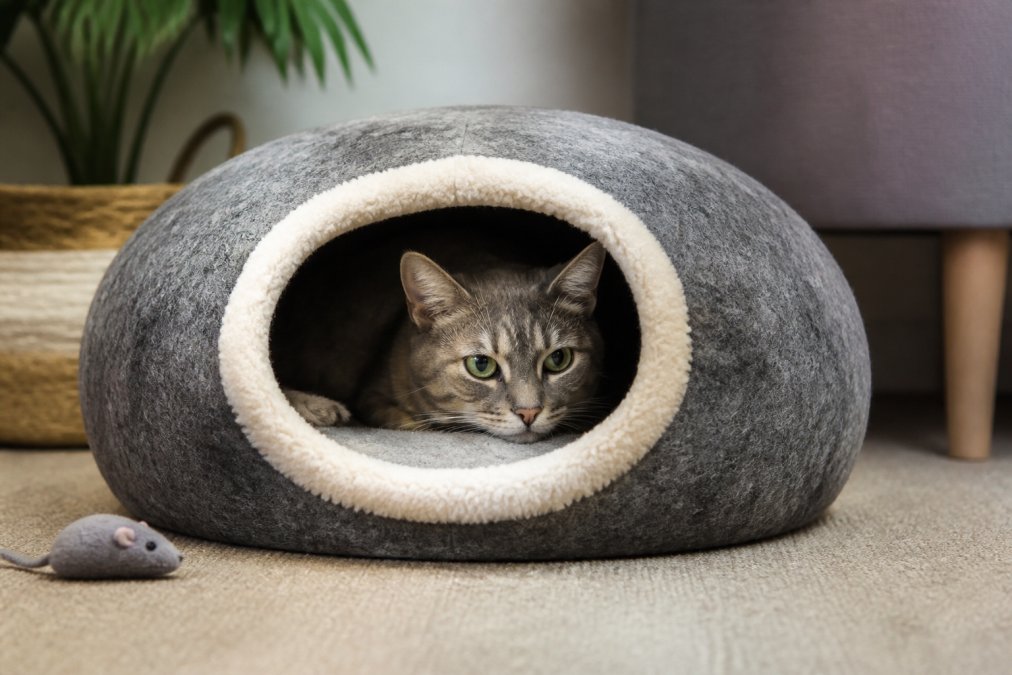
Enclosed cave beds work best for anxious cats because they block sightlines from every direction except the entry. Raised walls and a low-profile entry let your cat watch the room while staying hidden, the principle behind cocooning, where a small, dark, enclosed space signals safety. Bolster beds with high rims suit cats who want to curl but still see out.
Materials That Support Sensory Comfort
Plush fabric and fleece lining hold body heat, supporting thermal regulation and helping a stressed cat relax. Look for machine-washable covers, since anxious cats shed and sometimes mark. A non-slip base matters too, a bed that slides when your cat steps in will scare it off for good.
| Feature | Why It Helps | Best For |
|---|---|---|
| Enclosed cave shape | Blocks sightlines, mimics a den | Cats who hide constantly |
| Raised walls / bolster rim | Security with a view | Cats who startle easily |
| Fleece or plush lining | Holds warmth, soft to the touch | Older cats, thin-coated cats |
| Orthopedic support | Cushions joints | Senior cats with arthritis |
| Non-slip base | Stays put on hard floors | Tile and hardwood homes |
| Machine-washable cover | Easy cleaning, less odor | Multi-cat homes |
Calming Cat Beds for Anxiety: What to Look For
Calming cat beds for anxiety prioritize one thing: a predictable, low-traffic resting place. Run every option through this checklist before buying.
- Enclosed or semi-enclosed shape with a low entry
- Soft, warm lining such as fleece or plush
- Removable, machine-washable cover
- Non-slip bottom
- Size that lets your cat stretch out, not just curl
- Neutral, quiet color and no noisy attachments
How to Introduce a New Bed to a Shy Cat
Most guides stop at "be patient," which skips the mechanism: an anxious cat avoids a new bed because it smells foreign and sits in an unfamiliar spot. Fix both before you expect a single paw inside.
Why a New Bed Reads as a Threat
Cats navigate by scent and routine. A bed straight from the store carries manufacturing and shipping odors, with no trace of your home. To a nervous cat, that's an unknown object in known territory. The introduction period converts it from "unknown" to "mine."
The Scent-First Method
Do this before the bed goes on the floor:
- Neutralize the new smell. Air the bed out 24 to 48 hours in a room your cat does not use, or rinse a washable cover with no detergent.
- Transfer your cat's scent. Rub a clean microfiber cloth along your cat's cheek glands, chin, and tail base, then wipe it over the bed's interior. Repeat daily for the first week.
- Add a familiar object. A worn t-shirt or a blanket already in your cat's rotation beats a new toy.
- Layer in pheromones if needed. Apply synthetic feline facial pheromone spray to a cloth near the bed, not directly on the fabric, some cats dislike the wet spray smell.
Placement and the Slow Reveal
Put the bed where your cat already rests, not where you want it. If your cat naps behind the couch, start there, then migrate it a few feet at a time once it's being used.
Use food as a bridge, not a bribe:
- Days 1-3: Place treats a few feet from the bed.
- Days 4-7: Move treats to the bed's entrance, never inside.
- Week 2: Drop a treat on the bed's cushion and walk away.
- Week 3: If your cat is napping in it, stop the treats. The bed is now a resting spot, not a food station.
Signs the Introduction Is Working
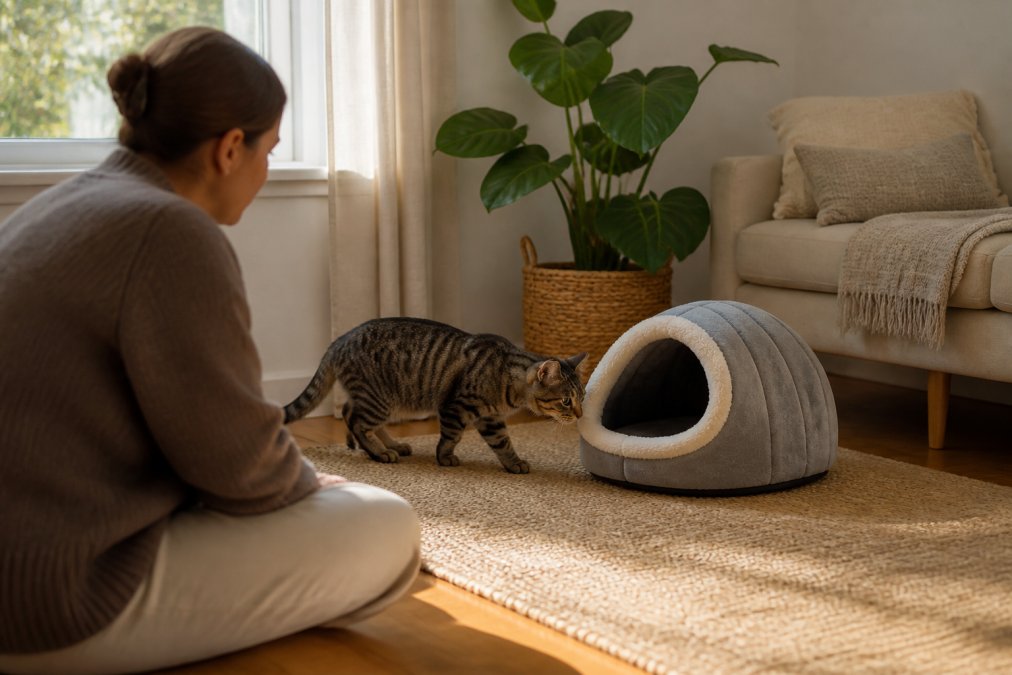
Progress looks like this: sniffing from a distance, approaching and circling, stepping in with front paws only, lying beside it, then settling inside. If your cat stalls more than a week at any stage, back up one step. Hissing, flattened ears, or bolting means the scent transfer isn't finished.
When to Try a Different Bed
If three weeks pass with no approach behavior, the bed may be the problem, too small, too tall an entry, or an unpopular fabric. Swap the cover first, then the bed, keeping the same location so the only variable is the object.
Where to Place Cat Beds for Security
Placement is where most anxious-cat bed purchases fail. A perfect cave bed in the wrong spot becomes a dust collector. The rule: an anxious cat needs a resting spot with a clear sightline to the room's entry, at least two walls or a solid back behind it, and an escape route that avoids walking past a threat.
Vertical vs. Floor Level: Match Placement to the Anxiety Type
Not all anxiety responds to the same height. Use your cat's behavior to pick the level:
| Anxiety Pattern | Best Placement | Why |
|---|---|---|
| Startles at sounds, doorbell, footsteps | Elevated (cat tree, shelf, top of a cabinet) | Height creates distance from floor-level noise and foot traffic |
| Hides under furniture when strangers visit | Floor level, tucked against a wall | Mimics the under-furniture den the cat already trusts |
| Avoids other pets in the home | Elevated, in a room the other pets do not use | Height plus separation removes the need to defend space |
| Paces at night, cannot settle | Floor level near your bed | Proximity to you is the calming factor, not enclosure |
| Senior cat with joint pain | Floor level, low entry, no jump required | Height becomes a barrier instead of a comfort |
Reading Your Home Layout Like a Cat
Walk through your home at your cat's eye level and count the exposed stretches it must cross to reach a resting spot. Anxious cats prefer routes with cover, along walls, behind furniture, under tables. A bed in the middle of an open floor forces an exposed crossing every time.
Good placement options:
- A corner with two walls behind it and a clear view of the door
- Elevated spots that use vertical territory, such as a shelf or cat tree, reachable without crossing a high-traffic zone
- Away from litter boxes, food bowls, and noisy appliances like washing machines and refrigerators
- Out of the path of foot traffic and slamming doors
- Near a heat source in winter, but not directly against a radiator or vent
Creating Quiet Zones in Multi-Cat Homes
Multi-cat homes need one bed per cat, plus one extra. Territorial behavior flares when cats share resources, and a single bed becomes contested. But count is only half the fix, beds must sit in separate quiet zones with independent access routes. Two beds side by side solve nothing; the anxious cat still passes the other cat to reach its bed.
Set up zones like this:
- One resource cluster per zone. Each quiet zone gets its own bed, water, and litter box if space allows, so a cat never leaves its zone for a basic need.
- Separate the zones by a door or a floor. Different rooms or levels beat different corners of one room.
- Give each cat its own entry and exit. A one-door closet bed is a trap if another cat can block it; choose spots with two ways out.
- Watch the chokepoints. Hallways, stair landings, and doorways host territorial conflicts, don't place a bed behind one.
Test the Spot Before You Commit
Before buying a second bed or moving one, spend a week watching where your cat already rests. Cats vote with their bodies. The spot it picks, a sunny windowsill, the back of a couch, a specific corner, is where the bed belongs. Work with that choice and the bed gets used from day one.
Common Mistakes to Avoid When Choosing a Cat Bed
A common mistake is buying for looks instead of behavior. The prettiest bed is useless if your cat won't go near it. Watch for these errors:
- Choosing a bed that's too small for your cat to stretch out
- Placing it in a busy hallway or beside a noisy appliance
- Skipping the wash and letting odors build up
- Buying one bed for a multi-cat home
- Expecting instant use on day one
Frequently Asked Questions
What is the best cat bed for reducing anxiety?
The best cat beds for anxious cats are enclosed cave beds with raised walls and a fleece lining. These designs mimic the denning behavior cats use for security. Look for a low-profile entry so your cat can slip in without feeling exposed, a non-slip base, and machine-washable fabric. Calming cat beds for anxiety work best when placed in a quiet zone your cat already visits.
Should I choose a covered or open bed for a nervous cat?
Most nervous cats prefer covered, enclosed cave beds because the raised walls block sightlines to anxiety triggers. However, some cats feel trapped in fully covered beds. If your cat has rejected a cave bed before, try a bolster bed with raised edges instead. It offers similar security while keeping an open top. Watch which one your cat chooses to sleep in and follow that preference.
How do I introduce a new bed to a shy cat without scaring them?
Place the bed in a room your cat already relaxes in, and leave it undisturbed for a few days. Do not put your cat in the bed. Instead, place a worn t-shirt or a toy near it so the bed picks up familiar scent. You can also sprinkle a little catnip or use a calming pheromone spray on the fabric. Let your cat approach on their own terms, which may take a week or more.
Where should I put a cat bed for an anxious cat?
Put the bed in a quiet zone with a clear view of the room's entry point, so your cat can see who approaches. Avoid high-traffic areas, loud appliances, and spots next to litter boxes. In multi-cat homes, give each cat a separate bed with vertical territory options like a shelf or cat tree nearby. A bed placed near a window works if your cat enjoys birdwatching, but keep a covered option available too.