 blog
Best Cat Tree for Multiple Cats: How to Choose One That Lasts
Last Updated: November 17, 2026
Quick Summary
The best cat tree for multiple cats has several separate climbing routes, enough platforms for every cat plus one extra, and a wide, heavy base that resists tipping. Start by counting your cats, then check stability and platform size before comparing styles. Tall trees should be anchored to a wall.
- Start with one perch per cat, plus one extra.
- Measure your largest cat and add a few inches for platform size.
- Choose a base at least as wide as the tallest platform.
- Do a wobble test after assembly and tighten every bolt.
- Anchor any tree taller than about four feet to a wall.
Table of Contents
- Why Multiple Cats Need a Different Kind of Cat Tree
- How to Size a Cat Tree for the Number, Size, and Temperament of Your Cats
- Stability, Build Quality, and Weight Capacity
- Reducing Conflict: Layout, Resource Distribution, and Separate Routes
- Top Cat Tree Features for Multi-Cat Homes: Condos, Beds, Baskets, and Ramps
- Placement, Cleaning, Repair, and How Long a Tree Lasts
- Choosing Your Multi-Cat Tree and Shopping Knead and Nuzzle
- Frequently Asked Questions
Why Multiple Cats Need a Different Kind of Cat Tree
A single cat tree that works for one cat often fails when a second or third cat moves in. Multiple cats need more perches, more separate routes, and more places to retreat. For shoppers with two or more cats, the common question is which tree will keep everyone comfortable without causing fights.
A cat tree is a multi-level scratching and climbing structure that gives cats vertical space, resting platforms, and hideaways. In a multi-cat home, the best cat tree is one with several separate climbing routes and enough platforms that cats can avoid each other when they want to.
Shopping for this can feel overwhelming. Focus on the features that matter for shared use, and you will narrow the field quickly.
How to Size a Cat Tree for the Number, Size, and Temperament of Your Cats
Size the tree to your household before you compare colors or styles. A tree that is too small becomes a bottleneck, and cats will compete for the top perch.
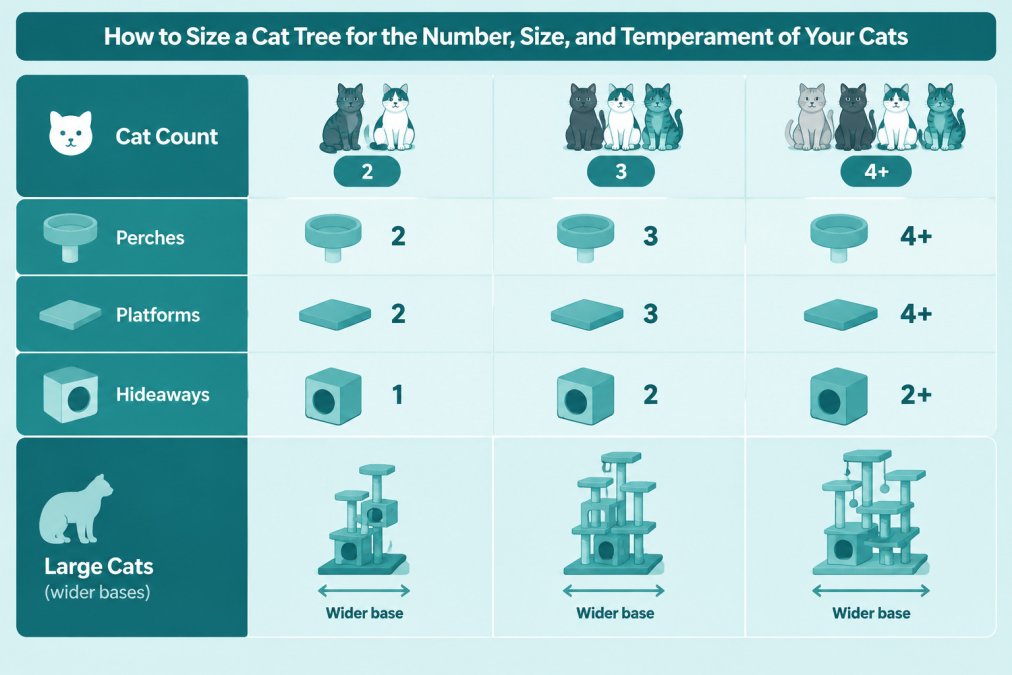
Start With a Perch Count, Then Add Buffer
A practical starting point is one perch or platform per cat, plus one extra. Count only surfaces a cat can actually lie on, a narrow shelf or a step does not count as a resting spot.
Perches at different heights matter as much as the total count. Cats that feel crowded tend to hide or stop using the tree, so spread the resting spots across several levels and avoid putting all the best spots on one side.
Match Platform Size to Your Largest Cat
Measure your largest cat from nose to the base of the tail while it is stretched out, and add a few inches. For beds built to suit heavy cats, see durable cat beds for heavy cats. A platform that is too short forces a big cat to hang over the edge, and a bed that is too narrow will be ignored. For a long-bodied breed such as a Maine Coon, look for platforms that are wider and deeper than average, and check the base footprint, a wide top on a narrow base is a tipping risk.
Account for Temperament, Not Just Headcount
Two confident cats that share well may be fine on a tree sized for two. A timid cat and an assertive cat need more separation. If one cat guards the top perch or blocks a route, add a second tree or choose a model with two distinct climbing paths so each cat can reach a high spot without passing the other.
Watch out: a tree that meets the perch count on paper can still fail if every perch sits on a single route, because one cat can block the whole structure.
Use a Simple Sizing Formula
Add up your cats, add one, and treat that as your minimum perch count. If floor space is limited, compact picks for small apartments can help you fit several cats into a small home. Then check three numbers on the product page: the number of separate climbing routes, the width of the largest platform, and the base footprint. If any of those is missing, ask the seller before you buy. A tree that fits your cats' sizes and temperaments will be used by every cat in the home, not just the boldest one.
Stability, Build Quality, and Weight Capacity
Stability is the most important factor in a multi-cat tree. Cats jump, land hard, and sometimes wrestle on the platforms, so the frame must hold. A tree that wobbles when one cat jumps down is a safety concern, not just an annoyance.
Check the Base and the Center of Gravity
A wide, heavy base is the first line of defense against tipping. Look for a base that is at least as wide as the tallest platform, and prefer a tree whose heaviest components sit low. A tall tree with a narrow base and a heavy condo near the top is the classic tipping setup.
Test for Wobble Before You Trust It
Once assembled, push the tree gently at the top platform. A small flex is normal; a sway that moves the base is not. If the tree moves, tighten every bolt, check that all posts are seated, and consider a wall anchor. Many tall trees ship with a strap or bracket for this purpose, use it, especially in homes with energetic cats or large breeds.
Read the Weight Capacity Carefully
Check the weight capacity listed on the product page before purchasing. Compare the stated limit to your heaviest cat, and remember that two cats landing on the same platform at once can briefly exceed a single-cat rating.
Inspect Materials and Hardware
Look for solid wood or heavy-duty engineered board for the core structure, and check that posts are wrapped tightly with sisal rope. For examples of sturdy construction built for active cats, see durable cat furniture options for active cats. Loose wrapping wears out fast under daily scratching. Check the hardware too: thicker bolts, metal brackets, and pre-drilled holes are signs of a tree built to be tightened and re-tightened over time.
Watch out: a tree that passes a wobble test on carpet can still slide on hard flooring, so check for non-slip feet or place a rug underneath.
Anchor Tall Trees
Any tree taller than about four feet should be anchored to a wall in a multi-cat home. Follow the manufacturer's instructions, locate a stud where possible, and re-check the anchor every few months. Anchoring is a simple safety step you can take, and it can help you place a tall tree near a window with less worry about tipping.
The article's key stability checks are summarised below.
| Check | What to look for | Why it matters |
|---|---|---|
| Base width | At least as wide as the tallest platform | Guards against tipping |
| Wobble test | Small flex is normal; base movement is not | Shows whether the frame is sound |
| Weight capacity | Compare the limit to your heaviest cat | Two cats landing together can exceed one-cat rating |
| Post wrapping | Tight sisal rope | Loose wrap wears out fast |
| Anchoring | Wall anchor for trees over about four feet | Reduces tipping risk |
Reducing Conflict: Layout, Resource Distribution, and Separate Routes
Many multi-cat problems start with resources that are too close together. Place the tree so each cat can reach a perch without passing directly through another cat's space.
Give each cat a separate route up the tree where possible. A tree with two or more climbing paths can give a timid cat a way to avoid a more assertive one. Put a scratching area, a water bowl, and a litter box in separate zones so the tree does not become a single contested hub.
Top Cat Tree Features for Multi-Cat Homes: Condos, Beds, Baskets, and Ramps
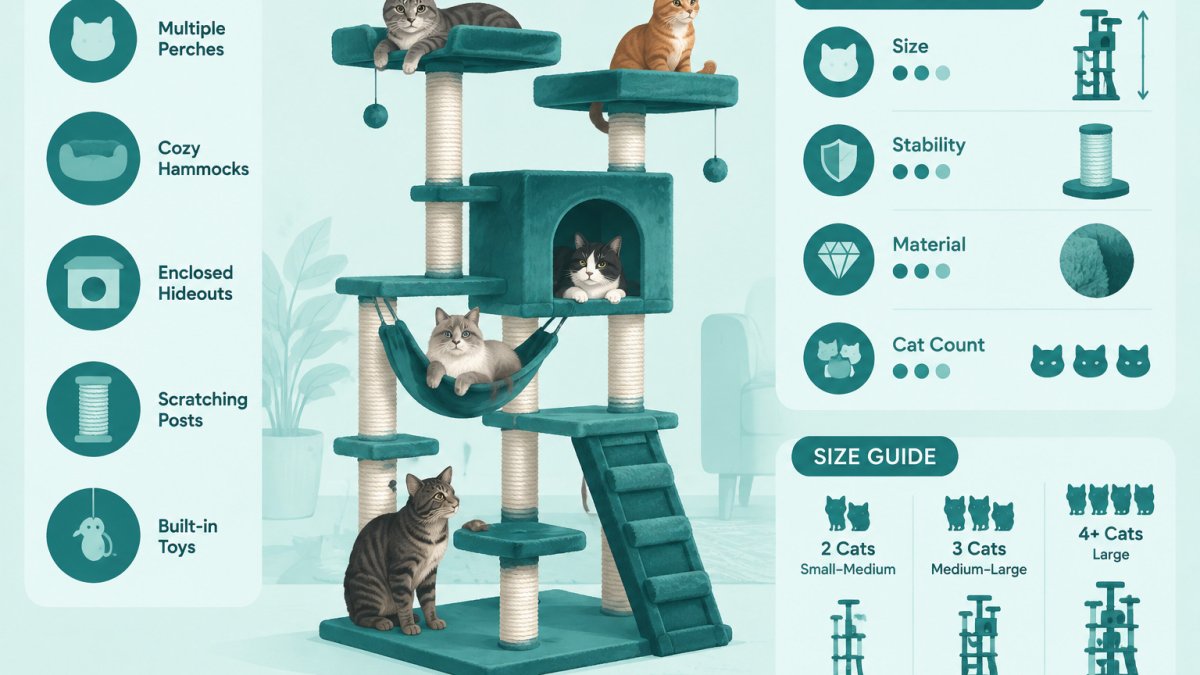
Look for a combination of features rather than a single standout element. Enclosed condos give shy cats a private retreat. Lounging platforms and beds give cats a comfortable place to rest. Baskets and ramps add variety for cats that prefer a low-effort climb.
Sisal-wrapped posts provide a durable scratching surface, and a dedicated scratching area keeps scratching away from furniture. Toys attached to the tree can keep younger cats busy, but make sure they are securely fixed.
Placement, Cleaning, Repair, and How Long a Tree Lasts
Place the tree near a window or in a common room where cats can see the household. For guidance on durable scratchers for apartments, including placement and how long they last, browse the full guide. Keep it away from doorways so it does not block traffic.
Vacuum the platforms and wipe the base regularly. Check the rope wrapping and the screws every few months. Replacing a worn scratching sisal post can be a practical alternative to replacing the whole tree. To help your cats adopt a new setup, read how to introduce new cat furniture step by step. Pricing depends on quantity, dates, and delivery, so check our website for current prices or a quote.
Choosing Your Multi-Cat Tree and Shopping Knead and Nuzzle
Start with your household count, then check stability, platform sizes, and the number of separate routes. A tree that fits your cats' sizes and temperaments will serve you for years.
Browse our cat furniture collection at Knead and Nuzzle to compare multi-level trees, condos, and beds for a shared home. We ship from the USA. Shop Now to find the right tree for your cats.
BUTTON: Shop Multi-Cat Trees CARD_TITLE: Need a tree for more than one cat? CARD_TEXT: Knead and Nuzzle carries sturdy, multi-level trees built for shared homes.
Frequently Asked Questions
What size cat tree do I need for multiple cats?
Size the tree to the cats, not just the room. A common approach is to give each cat at least one dedicated perch or resting spot, then add extra levels so cats can climb and rest without crossing paths. For two average-sized cats, a tree with three to four levels and a wide base usually works. For larger cats such as Maine Coons, choose a sturdier base with a broader footprint, since a narrow tree can wobble under heavier weight. Measure the floor space and ceiling clearance before ordering, and check the listed weight capacity.
How many perches should a cat tree have for two cats?
For two cats, aim for at least three to four distinct perches or platforms, with at least one enclosed hideaway such as a condo. Separate resting spots matter more than the total count: if both cats can lounge on different levels, the tree reduces competition for a single favorite spot. Shy or senior cats often benefit from a lower, enclosed space they can reach without passing through the other cat's preferred area.
What makes a cat tree stable enough for multiple cats?
Stability comes from a wide, weighted base, solid posts, and tight joinery. Look for thick, dense scratching posts that do not flex when a cat jumps on, and platforms bolted or screwed into the frame rather than resting loosely on it. Check the weight capacity listed by the manufacturer, and test the tree by pressing firmly on each level before letting cats use it. Anchoring the tree to a wall stud is an extra safeguard for tall models, especially in homes with more than one active cat.
Can large cats share a cat tree?
Yes, but the tree needs a broader base, sturdier platforms, and enough space between levels for heavier cats to move comfortably. Large cats such as Maine Coons put more load on each perch, so check weight capacity and avoid trees with narrow, lightweight platforms. Also consider whether all cats can reach the top levels, since a heavy cat may prefer lower, more supported perches.