 blog
blog
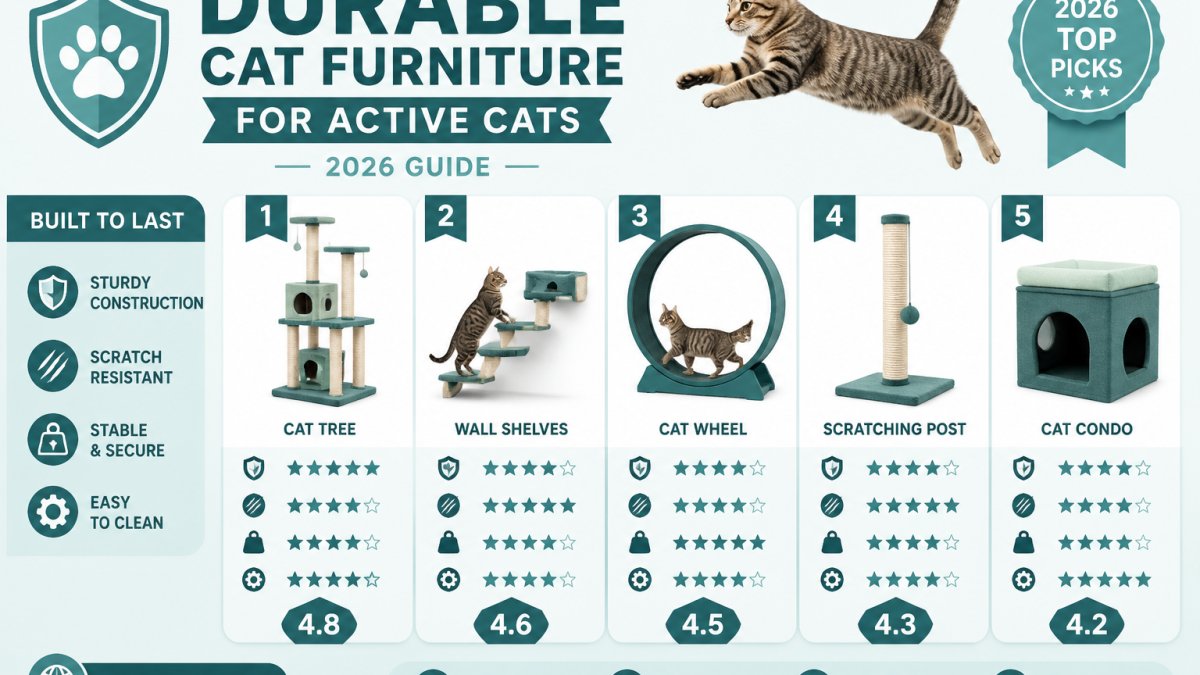
Durable Cat Furniture for Active Cats: 2026 Guide
Table of Contents
- What Makes Durable Cat Furniture for Active Cats Different
- Why a Sturdy Cat Tree Matters for High-Energy Felines
- Heavy-Duty Cat Tree Construction: Materials That Last
- Multi-Level Cat Activity Centers for Climbing and Play
- Wall-Mounted Cat Shelves for Space and Safety
- Matching Furniture to Your Cat's Energy Level and Size
- Assembly, Maintenance, and When to Replace
- Frequently Asked Questions
Last Updated: October 15, 2026
What Makes Durable Cat Furniture for Active Cats Different
Active cats demand more than casual loungers. A standard cat bed or basic scratching post won't satisfy a high-energy feline who climbs, jumps, and explores constantly.
The difference comes down to construction quality, material choice, and design intent. Furniture built for active cats uses reinforced frames, heavy-duty wrapping materials, and multi-level designs that distribute weight and activity across multiple platforms.
Most cat owners learn this the hard way: they buy affordable furniture that looks fine in the showroom, then watch their energetic cat destroy it within weeks.
Durable cat furniture for active cats solves this by prioritizing longevity.
Why a Sturdy Cat Tree Matters for High-Energy Felines
A sturdy cat tree is non-negotiable for active cats. These animals need vertical territory to climb, perch, and survey their domain. Without proper climbing structures, they redirect that energy into destructive behaviors: shredding furniture, knocking things off shelves, or developing stress-related issues.
Climbing also provides mental stimulation: each level offers different vantage points, textures, and play opportunities, so a cat burns energy productively rather than pacing and meowing out of boredom.
Stability and Tip-Over Prevention
A wobbly cat tree is dangerous. When a heavy cat launches from one platform to another, the entire structure experiences sudden forces. Unstable designs tip, potentially injuring your cat or damaging your home. Stability starts with a wide, heavy base that resists tipping even under dynamic movement.
The best designs use low centers of gravity and weighted bases. Look for bolted or welded frames rather than merely screwed ones, metal brackets or corner supports at connection points, and wall-mount kits that secure the structure to studs.
Test stability before purchase: a quality tree should feel rock-solid under moderate side pressure. If it sways or shifts, it's not suitable for an active cat.
Weight Capacity and Long-Term Support
Active cats are often larger and heavier than average, so a sturdy cat tree must support not just static weight but the impact forces of jumping and climbing. Weight capacity matters, but so does load distribution.
Multi-level designs spread activity across several platforms, and reinforced support posts running base to top distribute weight downward efficiently. Quality construction uses materials that resist fatigue after thousands of jumps.
Heavy-Duty Cat Tree Construction: Materials That Last
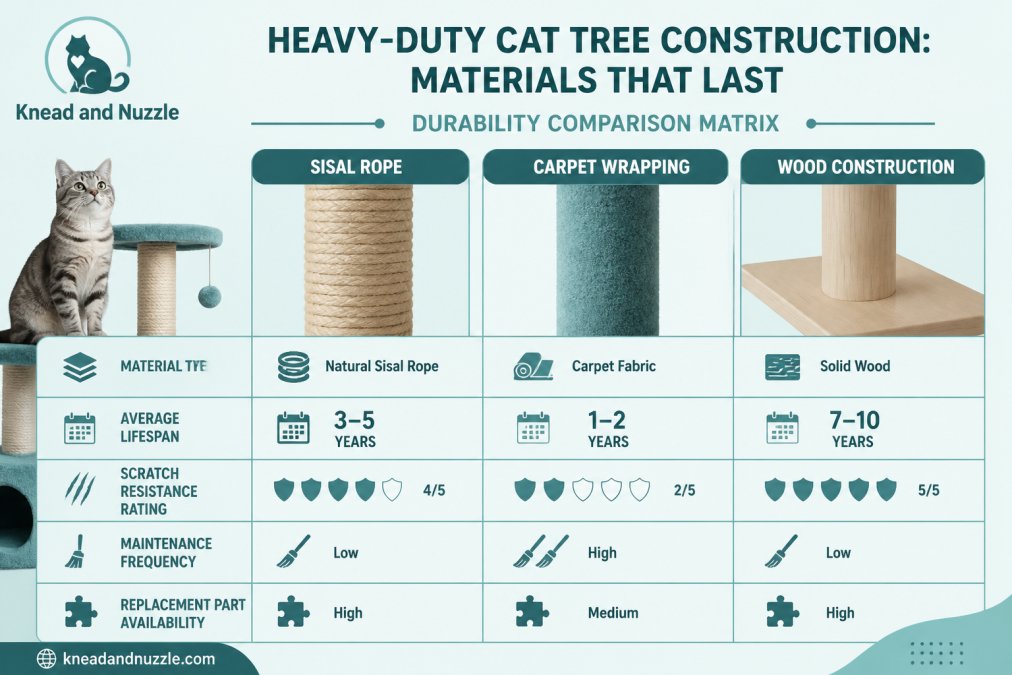
Construction quality determines how long durable cat furniture for active cats actually lasts. Three main material categories dominate: sisal rope, carpet wrapping, and wood construction. Each has different durability profiles and maintenance requirements.
Sisal Rope vs. Carpet Wrapping
Sisal rope is a natural fiber cats find highly satisfying to scratch, and it resists shredding better than many alternatives. However, it can unravel once damaged, is difficult to repair without replacing the whole wrapped section, and absorbs odor and moisture over time.
Carpet wrapping uses dense, industrial-grade fabric bonded to posts and platforms. Quality carpet resists scratching longer than sisal and is easier to clean, though some cats find it less satisfying. When it wears through, you can often replace just the wrapped section.
For active cats, carpet-wrapped posts with replaceable sleeves offer the best balance. You get durability plus the ability to refresh the furniture without full replacement.
Frame Reinforcement and Replaceable Components
The frame is the skeleton of any cat tree. Solid wood outlasts particle board or plywood, and hardwoods like pine or fir resist warping and splitting better than softer materials.
This shifts the cost model: invest in quality once and refresh components as needed, saving money and reducing waste over a decade.
Multi-Level Cat Activity Centers for Climbing and Play
Multi-level designs are essential for active cats. Each level serves a purpose: climbing routes, perching spots, play areas, and rest zones. A well-designed activity center keeps cats engaged throughout the day.
Active cats benefit from varied heights and textures: lower levels offer launching points, mid-level platforms provide perches for watching, and upper levels satisfy the instinct to reach high places.
The best multi-level designs create distinct zones, a play area with hanging toys, a quiet perch, and a scratching surface, giving your cat options that prevent boredom and encourage natural behaviors.
Consider the spacing between levels too. Platforms placed too far apart discourage jumping. Platforms too close together waste vertical space.
Wall-Mounted Cat Shelves for Space and Safety
Wall-mounted shelves offer an alternative to freestanding cat trees. They save floor space and create a climbing route across your walls. For active cats, shelves provide endless climbing paths and perching opportunities.
Wall shelves must be anchored to studs, not drywall alone; improper installation risks collapse and injury. Quality shelves use reinforced brackets rated for your cat's weight plus dynamic jumping forces.
Wall-mounted designs work well in smaller homes and apartments, keeping furniture off the floor and creating a three-dimensional play space cats enjoy.
Matching Furniture to Your Cat's Energy Level and Size
Most roundups treat "active cat" as a single category. In practice, active cats fall into distinct behavior profiles, and the right configuration depends on which profile fits your cat. Matching furniture to behavior, not just to body weight, is the angle most competitors skip.
Four Behavior Profiles and What Each One Needs
Climbers. These cats go up, wanting vertical routes, closely spaced platforms, and tall towers.
Jumpers. These cats launch with force in both directions, needing wide platforms (at least 14-16 inches for a large cat), a heavy base, and reinforced joints.
Scratchers. These cats work surfaces hard, needing multiple textures, sisal rope, sisal fabric, dense carpet, at both vertical and horizontal angles. One post gets destroyed quickly; three or four surfaces extend the life of each.
Multi-cat household members. When two or more active cats share furniture, you need a larger footprint with duplicate zones (two perches, two scratching surfaces, two hideaways) or two separate structures.
Sizing by Weight, Not by Breed Label
Breed labels are unreliable for furniture sizing. Use your cat's actual weight and body length:
- Under 10 lbs: Most quality trees rated for 20-30 lbs will hold up, but check platform diameter, small platforms discourage larger cats even when the weight rating is fine.
- 10-15 lbs: Look for weight ratings of at least 30 lbs per platform, and prefer trees with a base footprint of 24 inches or wider.
- 15-20 lbs: Prioritize solid wood posts over particle board, base footprints of 28 inches or wider, and trees that include wall-anchoring hardware.
- Over 20 lbs: Treat the tree as a piece of anchored furniture. Wall anchoring is not optional at this size, and platform spacing should be reduced to 10-14 inches to limit impact forces.
A Simple Configuration Checklist
Before you buy, match your cat's profile to these minimums:
- Climber: 4+ levels, 12-18 inch spacing, at least one tall vertical scratching post.
- Jumper: 24+ inch base, wide platforms, metal-bracket joints, wall anchor included.
- Scratcher: 3+ scratching surfaces in mixed textures and orientations.
- Multi-cat: duplicate zones or two structures; avoid single-perch designs.
If your cat fits two profiles, which is common, build to the more demanding one. A climber that also jumps needs both the height and the base.
Assembly, Maintenance, and When to Replace
This is the section most competitors skip entirely, and it is where active-cat owners actually lose money, not at purchase, but in premature replacement and avoidable repairs. Here is a practical upkeep framework.
Assembly: What to Expect and What to Check
Assembly difficulty varies more than buyers expect. Three common formats:
- Flat-pack with cam locks and screws. Most common. Expect 30-90 minutes for a mid-size tree. The weak point is the cam-lock joint; these loosen under repeated dynamic load and need re-tightening every few months.
- Bolted hardwood frames. Fewer parts, longer assembly, but far more resistant to loosening. Look for metal brackets at every joint rather than wood-to-wood screws.
- Pre-assembled or partially assembled. Heaviest to move, but eliminates the most common assembly error, under-tightening.
After assembly, load-test before your cat uses it: press firmly on each platform and the top perch, then rock the structure side to side. Any movement at the base or a joint means re-tighten or add anchoring.
A Monthly and Quarterly Inspection Routine
Active cats stress furniture in ways casual loungers do not. A short routine catches problems before they become injuries:
Monthly:
- Tighten all visible bolts and cam locks.
- Check sisal rope for loose strands or unraveling at the ends.
- Run a hand over carpet surfaces to feel for bare backing or exposed staples.
- Confirm wall anchors (if used) are still snug.
Quarterly:
- Check the base for cracks, especially where posts meet the platform.
- Test platform stability by pressing down firmly at the outer edge.
- Inspect hanging toys and their attachment points for fraying.
- Look for sagging in any platform that supports regular jumping.
Replacement Triggers, Not Replacement Schedules
"Replace every X years" is the wrong frame. Replace based on condition:
- Replace the sisal wrap as soon as strands unravel. Ingested fiber is a real risk, and a loose end invites more pulling.
- Replace a carpet section when backing material shows through or staples become exposed.
- Replace a platform when it sags visibly or flexes under moderate hand pressure.
- Replace the whole structure when the frame itself cracks, when joints no longer hold torque after re-tightening, or when two or more major components fail at once.
What Drives Long-Term Cost
Purchase price is only part of the picture. Three factors determine total cost over the furniture's life:
- Replaceable components. Trees with modular sleeves and bolt-on platforms let you refresh worn surfaces instead of replacing the whole unit. This is the single biggest cost lever.
- Material quality at the frame. A solid wood frame with metal brackets typically outlasts particle board by a wide margin, even when the wrapped surfaces are identical.
- Anchoring and stability. A tree that tips once often needs full replacement; a properly anchored tree rarely does.
A common pattern among active-cat owners is spending more upfront on a modular hardwood tree and refreshing sisal and carpet sections periodically rather than replacing an inexpensive tree every year or two. Over several years, the modular approach usually costs less and produces less waste.
Cleaning Without Damaging Materials
- Vacuum carpet surfaces with a brush attachment rather than a beater bar, which pulls fibers.
- Spot-clean with a damp cloth and mild soap; avoid soaking sisal, which can loosen the twist.
- Air-dry thoroughly before returning the furniture to use, trapped moisture degrades both rope and wood.
We ship from the USA, so new furniture arrives without the delays that come with overseas fulfillment.
Frequently Asked Questions
What type of cat furniture is best for active cats?
Active cats need multi-level structures that encourage climbing, jumping, and scratching. Look for durable cat furniture with multiple platforms, ramps, and varied heights. Heavy-duty construction using reinforced frames prevents wobbling during intense play. Wall-mounted shelves and activity centers also distribute play opportunities across vertical space, reducing wear on any single piece.
How do I choose a sturdy cat tree that won't tip over?
A sturdy cat tree needs a wide, weighted base that's at least one-third the height of the tree itself. Check the weight capacity, it should exceed your cat's weight by at least 50%. Look for frames made from solid wood or reinforced plywood rather than particle board. Anchor points for wall mounting add extra stability.
What materials make cat furniture more durable for active cats?
Solid wood frames outlast particle board by years. Marine-grade plywood resists moisture and damage better than standard plywood. Avoid thin fabrics; look for dense, tightly woven upholstery that resists snags and tears from claws.
Are wall-mounted cat shelves suitable for active cats?
Wall-mounted cat shelves work well for active cats when properly installed. They must be anchored directly into wall studs with heavy-duty brackets rated for dynamic weight (cats jumping and landing). Individual shelves should support at least 30 pounds each. They free up floor space and let you create climbing routes across multiple walls. Combine them with a heavy-duty cat tree for a complete, multi-functional play environment. Always verify installation instructions match your wall type.