 blog
Which Cat Toys Work Best in a Multi-Cat Home?
Last Updated: November 14, 2026
Quick Summary
The best multi-cat toys are ones that let several cats play at once and hold up to heavy use. Collapsible tunnels with two openings, wide covered ball tracks, and paired kicker toys work well for shared play. Give each cat its own toy and add a few shared options to reduce conflict.
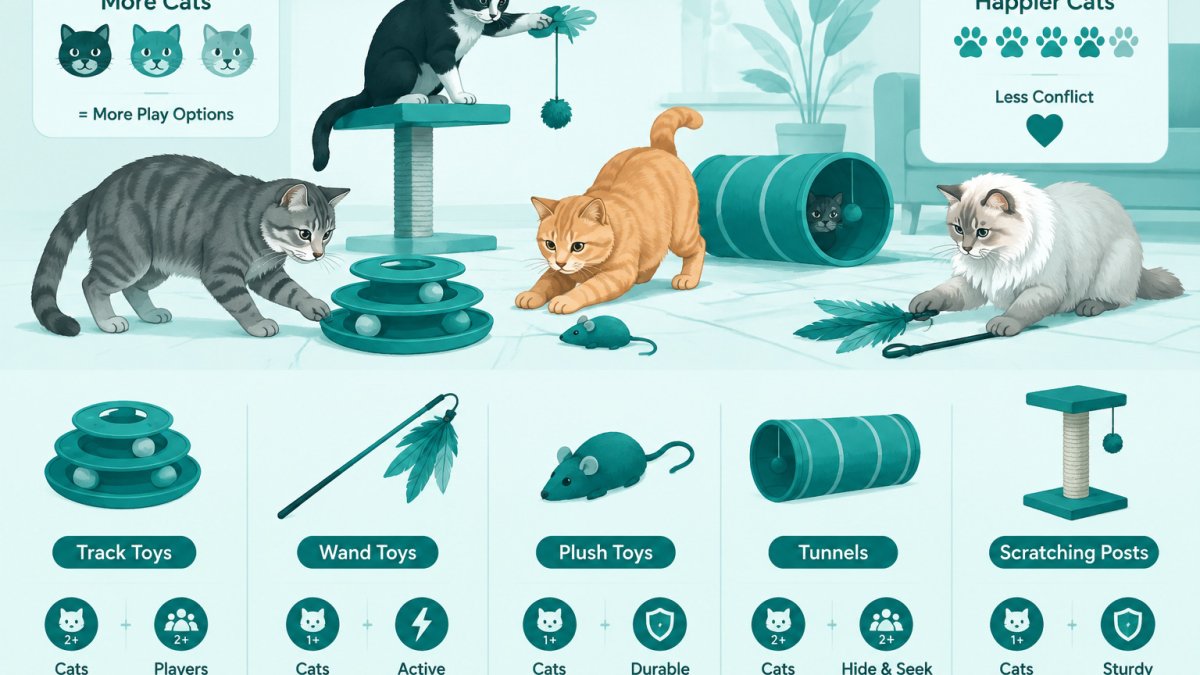
- Tunnels with two or more openings let one cat break away while another enters.
- Wide ball tracks with a covered top let two cats bat from opposite sides.
- Provide at least one toy per cat plus two or three shared options.
- Place toys in different rooms so no single spot becomes a battleground.
- Rotate toys in groups so the collection stays interesting.
Table of Contents
- Why Multi-Cat Homes Need a Different Toy Strategy
- Cat Toys for Two Cats to Play Together
- Stimulating Cat Toys for Indoor Cats
- Automatic Cat Toys for When You Are Away
- Best Cat Toys for Bored Cats
- How to Prevent Toy Conflict and Resource Guarding
- Building a Toy Rotation Schedule for Your Household
- Choosing Your Next Toys for Your Multi-Cat Household
- Frequently Asked Questions
Why Multi-Cat Homes Need a Different Toy Strategy
This guide is for owners juggling two or more cats. A toy that keeps one cat busy can end in a tug-of-war, a stolen toy, or a cat who never touches it at all. Multi-cat households need multi-cat toys chosen for group play, independent play and durability.
Most single-cat advice misses this. A feather wand works beautifully for one cat who wants your attention. With three cats, the same wand becomes a target for the most assertive cat, and the others lose interest. Think about how many cats will use a toy, when they will use it, and whether it can survive heavy handling. Our buyer's guide to picking durable toys walks through these checks before you spend money.
We recommend starting with three questions. Will the toy be shared, used alone, or both? How rough is the group? And can the toy be safely left out when nobody is supervising? Your answers will point you toward the right categories below.
Cat Toys for Two Cats to Play Together
Cooperative play works best with toys that let two cats chase, bat or pounce from different positions. The key is a toy with more than one approach: two openings, two lanes, or two ends. When one cat is ambushing from the tunnel, the other can approach from the open end, which reduces the one-cat-hogs-the-toy problem.
For a two-cat household, the most reliable shared formats are:
- Collapsible tunnels and crinkle tubes with two or more openings. A straight tunnel with a side vent lets one cat exit while the other enters. Look for a tunnel long enough that both cats can be inside without being cornered.
- Wide ball tracks with a covered top. A track with a single ball and a low profile lets two cats bat from opposite sides. Narrow tracks with one visible ball tend to produce a single cat parked over the ball.
- Feather wands used with two tips or a split line. A wand with a second lure on a short branch gives each cat a target. Move the wand in slow arcs across the floor rather than overhead, so both cats can track it from a crouch.
- Kicker toys in pairs. Two identical kickers give cats a toy each, so they can play side by side. Catnip-filled kickers can work well here because the scent draws cats to toys.
Match the toy to the pair's play styles. Two high-energy cats do best with chase-and-pounce toys that reward speed. A bold cat paired with a shy cat does better with parallel toys, two tunnels side by side, two wands, so the shy cat can play without being stalked. Two older or low-mobility cats often prefer floor-level rolling toys and wide tracks over anything that requires jumping.
Watch out: a toy that works for two calm cats can become a flashpoint for two competitive cats. If you see one cat blocking the tunnel exit or sitting on the track, switch to duplicate toys rather than a single shared one.
Set up shared toys in an open room with at least two escape routes. A tunnel pushed into a corner traps the cat inside; a tunnel placed across the middle of a room lets either cat break away. For a shared play space, consider this multi-cat tunnel bed with hanging ball and soft mat. Rotate which shared toy is out each session so the same cat does not learn to claim the same setup every time.
Stimulating Cat Toys for Indoor Cats
Indoor cats need physical and mental stimulation, especially when they cannot go outside to hunt. Toys that move unpredictably, like a wand with a ruffled feather tip or a kicker toy filled with catnip, mimic prey and encourage short bursts of activity.
Puzzle feeders and treat dispensers add a mental challenge. For a stimulating space that multiple cats can climb and play in, try this cardboard scratching house. A cat that works for a kibble reward often stays engaged longer than one that simply eats from a bowl. Choose sizes that suit your cats; a toy too small can be swallowed or chewed into loose pieces.
Stop while they are still interested.
Automatic Cat Toys for When You Are Away
Battery-powered toys can keep cats entertained when nobody is home. Rolling balls, motion-activated mice and slow-moving wands are the most common choices. They work best as independent-play toys, so set them up when you leave and remove them before you return if they could cause conflict.
Check the battery compartment regularly. Cats can chew open cheap battery covers, so choose toys with secured compartments and inspect them before each use. Do not leave electronic toys with loose parts unattended for long periods.
Rotate automatic toys so they stay interesting. A toy that runs every day loses its appeal within a week or two.
Best Cat Toys for Bored Cats
Rotating a handful of simple toys can help each one feel new again.
Good candidates include crinkle balls, catnip-filled plush toys and interactive wands. Choose toys that let cats pounce, bat and carry them. For cats with a strong prey drive, a toy that can be dragged or chased works especially well.
Watch for signs that a toy is getting too rough. Cats that bite or shred toys quickly need durable options, and any toy with small parts should be removed once it starts to come apart. See our selection of durable cat toys for aggressive chewers built to hold up to heavy use.
How to Prevent Toy Conflict and Resource Guarding
Toy conflict usually starts when one cat tries to control a toy the others want. Resource guarding can show up as hissing, swatting, blocking a doorway, sitting on a favorite toy, or a low growl when another cat approaches. Catching it at the growl stage is far easier than breaking up a scuffle.
Provide more toys than you think you need. A workable rule is one toy per cat plus two or three shared options, all available at the same time. Two cats need at least four toys out; three cats need at least five. Place them in different rooms so no single spot becomes a battleground, and put the highest-value toys (catnip kickers, treat puzzles) in separate zones rather than clustered in one corner.
Separate the play sessions when guarding appears. If the same cat guards toys repeatedly, run short individual sessions with each cat in a closed room, then bring them back together for a low-stakes shared toy like a ball track. Individual sessions let the guarding cat burn off drive and let the other cat play without interruption.
Pick up toys after each session when a cat seems possessive. Putting a toy away briefly often ends the dispute. Store it out of sight rather than on a shelf the cats can reach, because a visible toy can restart the standoff.
Watch the feeding and resting areas too. Resource guarding around toys often spills over from food or bed guarding. If a cat guards a food bowl, feed cats in separate rooms and keep toy play away from those spots.
Watch out: never punish a guarding cat by removing all toys. That tends to increase possessiveness over the toys that remain. Remove only the contested toy, and replace it with two duplicates in separate locations.
For larger groups, add a second tier of toys that only come out during supervised group play.
Building a Toy Rotation Schedule for Your Household
A rotation schedule keeps toys fresh and reduces conflict. Divide your collection into groups, such as shared toys, solo toys and automatic toys. Put one group out each day or each few days, then swap.
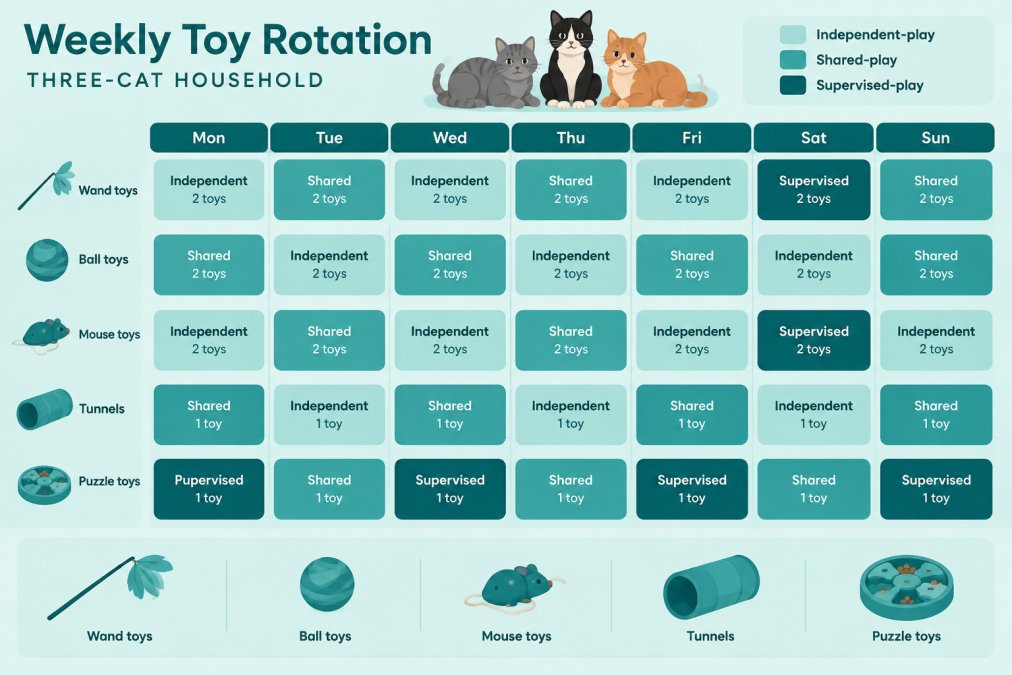
For a three-cat household, you might set up independent-play toys in the morning, a shared wand session in the evening and an automatic toy overnight. Keep notes on which toys get used and which get ignored, then adjust the rotation.
Store out-of-rotation toys somewhere cats cannot reach. This keeps the collection looking new and makes restocking a simple swap rather than a trip to the store.
Choosing Your Next Toys for Your Multi-Cat Household
Start with the categories above that match your cats' habits. If they play together, tunnels and wide ball tracks are a good base. If they are loners, add automatic and puzzle toys. Buy one or two options first, see what the cats use, then expand.
Browse the cat toys section at Knead and Nuzzle to find something that fits your household. Shipping is available from the USA.
Use the categories above to match toys to how your cats actually play.
| Toy type | Best for | Key difference |
|---|---|---|
| Collapsible tunnels and crinkle tubes | Two cats playing together | Two or more openings let cats break away |
| Wide ball tracks with covered top | Two cats batting from opposite sides | Low profile; avoids a single cat parking over the ball |
| Feather wands with a second lure | Cats playing side by side | Slow arcs across the floor let both track it |
| Kicker toys in pairs | Cats that want their own toy | Identical toys reduce competition |
| Battery-powered toys | Independent play when you are away | Check battery covers regularly; rotate for interest |
| Puzzle feeders and treat dispensers | Mental stimulation for indoor cats | Cats often stay engaged longer than with a bowl |
Frequently Asked Questions
What are the best cat toys for a family with multiple cats?
The most useful toys for multiple cats are ones that support both shared and solo play. Interactive wands and chase toys let two cats play together, while tunnels, puzzle feeders and ball tracks keep a cat busy when others are asleep or elsewhere. Choose sturdy toys with no small detachable parts, and buy duplicates or extra sets of popular items so cats are less likely to compete over a single favorite. Watch the first few sessions to see which toys draw cats together and which cause tension.
How do you keep multiple cats from fighting over toys?
Start by offering more toys than you have cats, and keep a few in reserve so you can rotate them. Use wand toys for group sessions and put away toys that trigger guarding. Give each cat a separate feeding and resting spot with its own toy, and supervise the first play sessions with a new item. If one cat repeatedly takes toys from another, you may choose to separate them during play.
Are automatic cat toys good for homes with multiple cats?
Battery-powered balls, rolling tracks and motion toys give cats something to chase during the day, though they should be checked for wear and kept away from cats that may chew or swallow parts. Pair them with several non-electronic options, such as tunnels and puzzle feeders, so the toys do not become the only source of stimulation.
How can I entertain cats when they are home alone?
Cats left alone do best with a mix of toys that need no help from you. Puzzle feeders and treat dispensers make cats work for food, tunnels and boxes offer hiding places, and rolling balls or tracks give them something to bat around. Rotate these toys every few days so they stay interesting.