 blog
Cat Scratcher Furniture for Small Homes in 2026
Last Updated: November 28, 2026
Quick Summary
Cat scratcher furniture for a small home should be chosen by footprint, surface material, and stability. Measure the floor spot and clearance first, and choose sisal for durability or jute for softer texture. A compact vertical post or combination piece usually fits best.
- Measure the floor spot and leave clearance so your cat can stretch fully along the post.
- Sisal is generally more durable under heavy scratching; jute is softer underfoot.
- Run a tip test: a post that lifts a base edge before the wrap gives is too light.
- Freestanding scratchers avoid drilling into walls, which helps protect your rental deposit.
- Place the first scratcher where your cat already scratches, and shipping from the USA is available.
Table of Contents
- How much room does cat scratcher furniture need in a small home?
- Sisal vs. jute cat scratcher: which surface holds up better?
- Compact cat scratching post options for apartments
- Vertical versus horizontal scratchers in tight spaces
- Room-by-room placement and renter-friendly setup
- DIY cat scratcher furniture review for small homes: what to build and what to skip
- Choosing your first scratcher for a small home with Knead and Nuzzle
- Frequently Asked Questions
Cat scratcher furniture for small homes is about more than picking a pretty post. Knead and Nuzzle has put together this guide to help you choose a scratcher that fits your space, holds up to daily use, and keeps your cat away from the sofa. The practical trade-offs below cover footprint, surface material, stability, and where to place each piece in a rental.
How much room does cat scratcher furniture need in a small home?
The real requirement for most compact scratchers is clearance. Leave room for your cat to stretch fully along the post, usually a few inches beyond its height when extended. Measure the spot before you shop, and check the product's listed dimensions rather than guessing from photos.
Small homes benefit most from scratchers that stand flat against a wall or tuck into a corner. A post that blocks a walkway in a studio gets ignored or knocked over. Choose a footprint that leaves at least a clear path through the room.
Sisal vs. jute cat scratcher: which surface holds up better?
Sisal is generally considered the more durable material for heavy scratching, while jute is softer underfoot. Check the product details for each surface before you buy.
Texture preference matters too. Some cats prefer the rougher bite of sisal, while others like the give of jute. Learn how to get a cat to use a scratching post once you have picked the orientation that suits your space.
A loose, frayed surface can snag claws, so inspect the wrap quality before you buy.
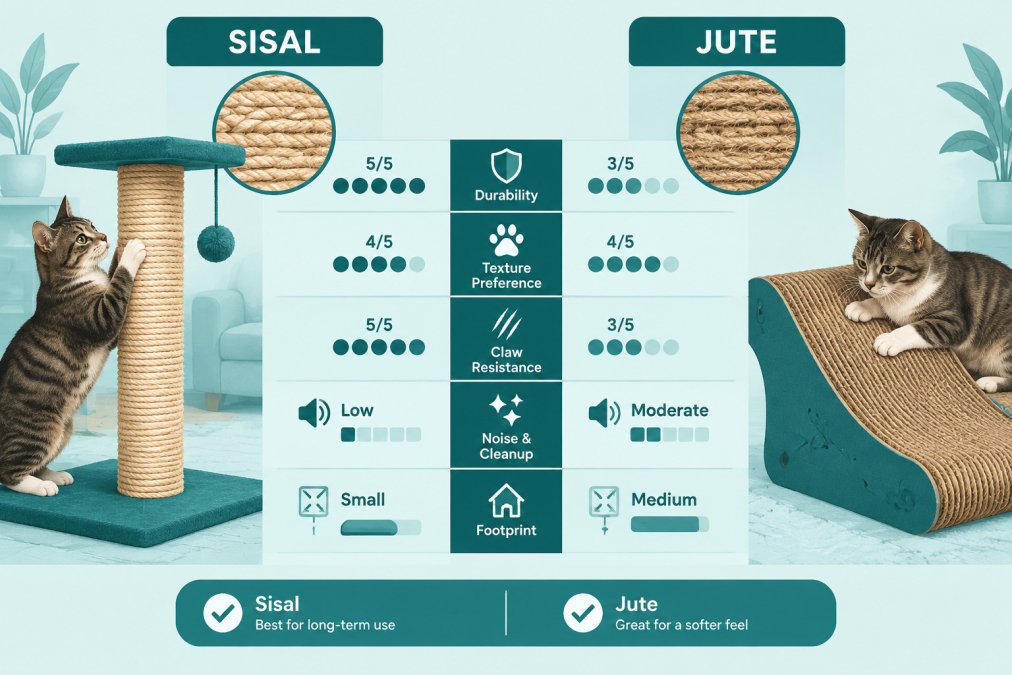
The two surfaces differ mainly in durability and texture, as summarised below.
| Surface | Key difference |
|---|---|
| Sisal | Generally more durable under heavy scratching |
| Jute | Softer underfoot |
| Sisal | Rougher bite some cats prefer |
| Jute | Give some cats like |
| Either | Inspect wrap quality for loose, frayed surfaces |
Compact cat scratching post options for apartments
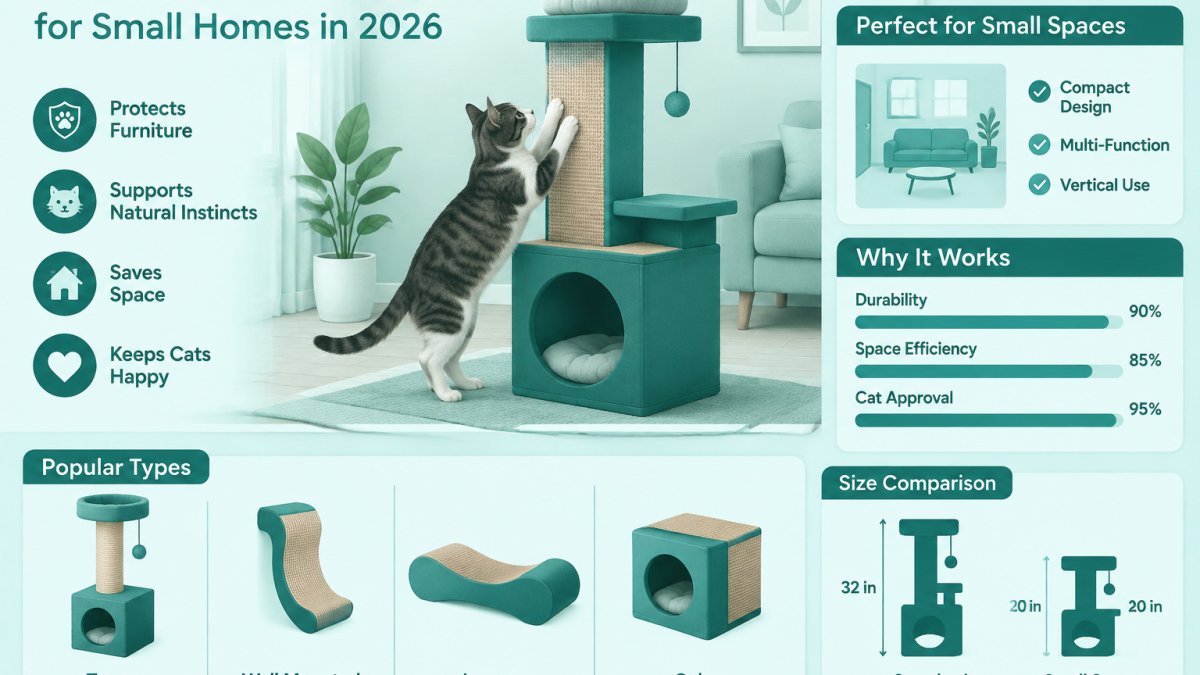
When space is limited, a compact post with a narrow base and a tall, slim profile does the job. A post under three feet tall that still lets your cat reach full extension suits many small homes. See the scratcher and bed two-in-one, a compact option that combines both in one footprint.
Best for: cats that scratch vertically and households with limited floor space. Skip if: your cat is large or prefers to lounge on top of its scratcher for long periods.
Combination pieces that include a bed or a perch can save room, since one footprint does two jobs. Check that the platform is wide enough for your cat to sit comfortably.
Measured footprint and storage dimensions
Small-space shopping goes wrong when you compare photos instead of numbers. Before you buy, pull three figures from the product page and write them down: base footprint (width times depth), overall height, and usable scratching height (the wrapped section your cat can actually reach). When comparing posts, check the base footprint, overall height, and usable scratching height on each product page.
Storage matters as much as placement. If storage is a concern, look for a post that breaks down into parts, which can be easier to stow between uses.
A repeatable small-home test you can run in five minutes
You do not need a lab to separate a good compact post from a wobbly one. Run the same four checks on every candidate:
- Tip test. Set the post on a hard floor and pull the top toward you with steady pressure, roughly the force a cat uses when it hooks and stretches. A post that lifts a base edge before the wrap gives is too light for a strong scratcher.
- Wrap test. Press a fingernail into the sisal and drag. Tight, evenly spaced wrap resists; loose wrap with visible gaps will shed and snag.
- Usable-area test. Measure the wrapped height and confirm your cat can stretch to full length without its front paws running off the top.
- Wobble test. Nudge the post from the side. A hollow knock and visible flex at the joint mean the column is thin or the connection is loose.
Record the numbers next to each model so you compare like with like instead of by memory.
Noise, debris, and cleanup in a compact space
A small apartment amplifies everything a scratcher does. Scratcher materials differ in how much they shed and how loud they are, so consider how much debris and sound you can tolerate in your space. If your scratcher sits in a bedroom or a shared living space, favor a solid column and a tight wrap, and put a small mat under the base to catch debris and dampen sound.
Long-term cost and replacement frequency
Purchase price tells you little about value in a small home, where one piece has to last. Think in cost per month: divide the price by how many months the scratching surface survives regular use. Durability varies by construction, so track how long the scratching surface lasts with regular use.
Vertical versus horizontal scratchers in tight spaces
Vertical scratchers suit cats that stretch upward to claw and generally take up less floor area. Horizontal scratchers lie flat and can fit under a sofa or along a wall where height is limited.
Most cats use both. If you have room for only one, watch how your cat scratches now. A cat that claws the sofa arm while standing will usually take to a vertical post, while one that scratches the floor prefers a flat pad.
Footprint math: floor area versus wall area
The trade-off is simple once you put numbers on it. A vertical post consumes a small floor patch, roughly the base footprint, but claims vertical wall space and needs clearance on the pull side. A horizontal pad consumes more floor area but almost no height, so it slides under furniture or along a baseboard where a post would block a walkway. In a narrow room, a flat pad along a wall often preserves the walking path better than a post in the middle of the floor.
Room-by-room placement that actually works
Placement decides whether a scratcher gets used. Put the first one where your cat already scratches, such as beside the sofa arm or near a favored doorway, so the new surface becomes the easier option. In a rental, freestanding pieces avoid drilling or wall attachments, which keeps your deposit safe. In a studio, a vertical post in a corner and a flat pad under the coffee table cover both scratching styles without crowding the room. Avoid spots that block a door, a litter box, or the path to either.
Senior and mobility-limited cats
Not every cat can stretch to full height. Older cats and cats with limited mobility do better with a low-entry horizontal pad or a short, wide-based post they can reach without jumping. Look for a low profile, a stable base, and a surface at floor level or just above it. A tall post your cat cannot comfortably reach goes unused, no matter how well it is built.
Stability and tip resistance in small rooms
A scratcher that rocks or tips is quickly abandoned. Look for a wide, weighted base and check that the post stays upright when your cat pulls on it. In a small room, a heavier base reduces the chance of a tip-over that could startle your cat or damage nearby items. Run the tip test described above before you trust a new post with a strong scratcher.
Noise and debris by orientation
Orientation changes the cleanup burden. A horizontal cardboard pad sheds flakes directly onto the floor and is easy to sweep but noisy under hard scratching. A vertical sisal post drops fibers downward along the column, where a small mat catches them, and tends to be quieter. In a compact living space, match the orientation to where you can tolerate debris and sound, not just to your cat's preference.
Room-by-room placement and renter-friendly setup
Place scratchers where your cat already scratches, such as near the sofa or a favored doorway, so the new post becomes the easier option. Read why cats scratch furniture and how to redirect them to choose the right spot.
Start with one scratcher in the main living area, then add a second near where your cat sleeps if your home has more rooms. Avoid placing a post where it blocks a door or a litter box.
DIY cat scratcher furniture review for small homes: what to build and what to skip
Homemade scratchers can work for simple designs, such as a short wrapped post on a sturdy wooden base. They are cheapest when you already have the tools and materials. Skip DIY builds that rely on a thin base, loose wrap, or a tall post with no bracing, since these tip easily and wear out quickly.
For most small homes, a tested commercial scratcher saves time and removes the guesswork about stability and surface quality.
Choosing your first scratcher for a small home with Knead and Nuzzle
Start with a compact vertical post or a combination piece, consider sisal for durability, and confirm the footprint fits your floor plan. Find cheap cat furniture that lasts to match your budget to a piece that will hold up.
Browse Knead and Nuzzle's cat furniture collection to find a post that fits your space and your cat's habits, and check the website for current prices and availability. Shipping from the USA is available.
Frequently Asked Questions
How much floor space does a cat scratcher need?
A compact scratcher usually needs about the footprint of a floor lamp base, plus enough clearance for your cat to stretch along the post. Check the listed dimensions before you buy.
Is sisal or jute better for a cat scratcher?
Sisal generally lasts longer under heavy scratching, while jute is softer and often less expensive. Choose based on how hard your cat scratches and which texture it prefers.
Can I keep a cat scratcher in a rental?
Yes. Freestanding scratchers avoid drilling or wall attachments, so they suit rentals well.
Frequently Asked Questions
What kind of furniture is most resistant to cat scratches?
Furniture with tight-weave, scratch-resistant upholstery such as microfiber, leather, or densely woven synthetic fabrics holds up best. Hard surfaces like sealed wood or laminate are easier to clean but can show scratches. In a small home, pairing furniture with a dedicated scratcher placed near the favored sofa arm often redirects scratching more effectively than protecting the furniture alone. Test any protector or fabric on a hidden spot first.
Which is better for a cat scratching post, sisal or jute?
Sisal is generally considered tougher under heavy scratching, while jute is softer underfoot. Check the product details for each surface before you buy. For small homes, choose the material your cat already uses and check that the post is wrapped tightly and securely anchored so it stays stable.
What cat furniture works best in a small home?
Compact, multi-purpose pieces work best in small spaces. Look for a narrow base with a stable footprint, a scratching surface that doesn't require a large floor area, and designs that can tuck into a corner or beside a wall. Furniture that combines scratching with a resting platform saves space while giving your cat more than one useful function.
Where should you place a cat scratcher in a small home?
Place the scratcher near where your cat already scratches or rests, such as beside a sofa or near a sleeping spot. Keep it away from doors and walkways so it doesn't block movement, and avoid placing it where it could tip. Renters can use freestanding models that need no mounting, which keeps walls and fixtures intact.