 blog
How to Choose Cat Grooming Tools for Beginners
Last Updated: October 25, 2026
Quick Summary
The best cat grooming tools beginners need are a slicker brush or rubber brush for everyday brushing, a metal comb for detangling, and optionally an undercoat rake for long-haired cats. Start with just one or two tools, use them consistently for two weeks, then add others based on your cat's coat type and temperament.
- A minimal starter kit requires only one brush plus one metal comb to build a sustainable grooming habit.
- Slicker brushes work for both short and long coats, while rubber brushes feel like hand massage and suit cats that resist traditional tools.
- Long-haired cats need brushing three to four times weekly, while short-haired cats typically need once or twice weekly sessions.
- Introduce grooming tools slowly over two to three weeks using a four-step acclimation plan to prevent stress and negative associations.
- Clean your brush after each session and soak metal tools weekly in warm soapy water to maintain effectiveness and prevent bacterial buildup.
Table of Contents
- Why Cat Grooming Tools Matter for Beginners
- Building Your First Cat Grooming Kit for Beginners
- Best Cat Brush for Short Hair: What Beginners Need to Know
- Best Cat Brush for Long Hair: Managing Tangles and Mats
- How to Brush a Cat Without Stress
- Caring for Your Grooming Tools: Cleaning and Maintenance
- Getting Started with Your First Grooming Session
- Frequently Asked Questions
Why Cat Grooming Tools Matter for Beginners
Starting a grooming routine with your cat brings better health, stronger bonding, and a cleaner home, and cat grooming tools beginners can use make all the difference.
At Knead and Nuzzle, we know that choosing cat grooming tools beginners can actually use is the foundation of a sustainable habit.
The challenge is knowing which tools match your cat's coat type, temperament, and your comfort level.
Building Your First Cat Grooming Kit for Beginners
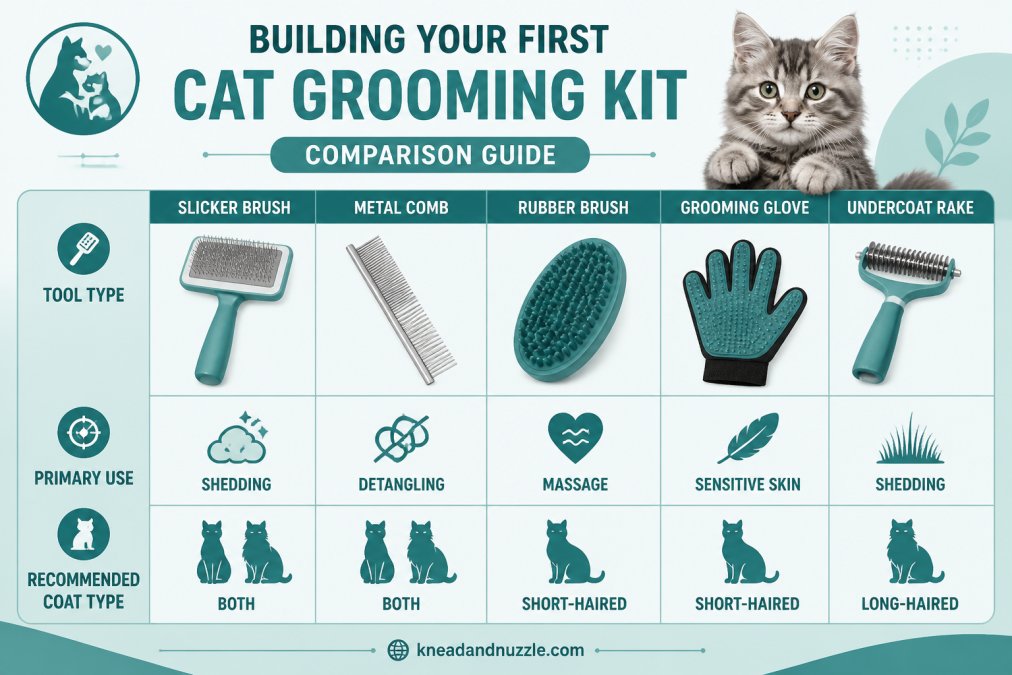
Your first grooming kit doesn't need to be elaborate. Most beginners succeed with three to five tools covering the main tasks: removing loose fur, detangling, and gentle massage. Choose tools by the job they do, not the size of the set.
Start with the task, then pick the tool
Beginners get overwhelmed because they shop by product category instead of grooming task. Match each job to the right tool:
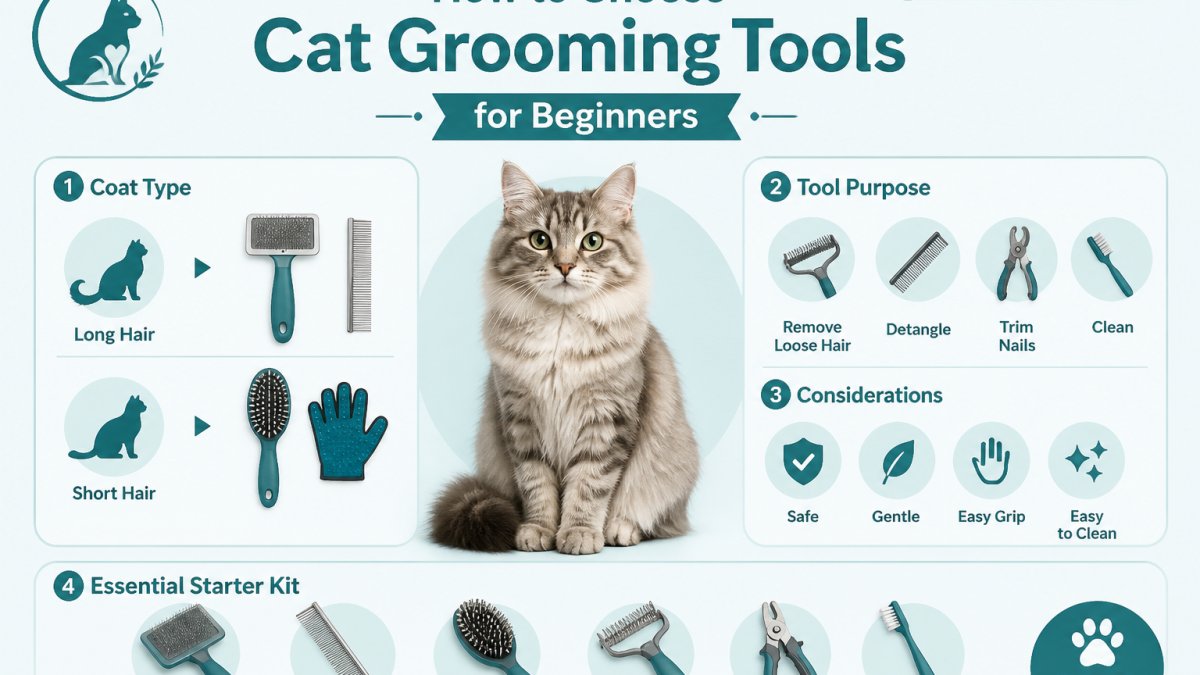
- Everyday brushing and loose-fur removal: A slicker brush handles both short and long coats, making it the most versatile starting point. The fine wires catch loose fur and small mats without being too aggressive.
- Detangling and finishing: A metal comb with both fine and wide teeth gives you options. Use the wide side first on stubborn tangles, then the fine side for a finishing pass.
- Cats that resist brushing or have sensitive skin: A rubber brush or grooming glove feels more like a hand massage than a tool, so many cats tolerate it when they won't sit still for metal bristles.
What beginners actually need versus what can wait
A minimal starter kit is one brush matching your cat's coat plus one comb, enough to build the habit. Everything else is optional until a specific problem appears:
- Must-have: One slicker brush (short or long coat) or one rubber brush (sensitive cat), plus a metal comb for detangling.
- Add if needed: An undercoat rake for dense undercoats or long-haired cats prone to mats.
- Optional: Grooming gloves, nail clippers, ear-cleaning supplies, and self-grooming brushes. Buy these only when a specific need appears.
This prevents the common mistake of buying everything at once and abandoning the routine when it feels like too much.
Budget tiers for a first kit
You don't need to spend a lot to start. Think in tiers:
- Minimal tier: A single slicker brush or rubber brush. This is enough to begin a twice-weekly routine.
- Starter tier: A brush plus a metal comb. This covers everyday brushing and detangling for most coats.
- Complete tier: Add an undercoat rake or grooming glove for long-haired or sensitive cats. This is the point where most beginners stop.
Skip bundled kits with tools you won't use. A Pet Grooming Tool Set for Cats & Dogs offers variety while you learn what your cat prefers, but only if every piece matches a task you plan to do.
The Double Sided Pet Grooming Brush from Knead and Nuzzle combines efficiency with ease of use: the flexible rubber backing stays comfortable during longer sessions, and the dual-sided design replaces multiple tools.
Start with one or two tools, use them consistently for two weeks, then add others based on what you learn about your cat's coat and temperament. Shipping from the USA means your starter tools arrive quickly, so the two-week trial can begin without a long wait. Learn which brushes are best for managing shedding when building your first kit.
Match each grooming task to the right tool for your cat's needs and temperament.
| Grooming Task | Best Tool | Why It Works |
|---|---|---|
| Everyday brushing and loose-fur removal | Slicker brush | Fine wires catch loose fur without aggression |
| Detangling and finishing | Metal comb with fine and wide teeth | Wide side tackles tangles, fine side finishes |
| Cats that resist brushing or have sensitive skin | Rubber brush or grooming glove | Feels like hand massage, better tolerated |
| Dense undercoats and stubborn mats | Dual-sided undercoat rake | 9 teeth for mats, 17 teeth for thinning |
| Nail care and ear cleaning | Specialized clippers and supplies | Secondary skills to master after brushing |
Best Cat Brush for Short Hair: What Beginners Need to Know
Short-haired cats need less intensive grooming than long-haired varieties, but they still shed and benefit from regular brushing.
A slicker brush works well for short coats, but many beginners find a rubber brush more enjoyable for both cat and owner.
For short-haired cats with denser undercoats, a grooming glove offers a gentler alternative.
Short-haired cats typically need brushing once or twice weekly, though indoor cats shed year-round and benefit from more frequent sessions in spring and fall.
Best Cat Brush for Long Hair: Managing Tangles and Mats
Long-haired cats demand more attention, and tool selection becomes critical. Mats form when loose fur tangles with the undercoat, trapping moisture and creating uncomfortable clumps.
Start with a metal comb featuring fine and wide teeth.
For stubborn mats, a dual-sided undercoat rake like the Pet Grooming Tool 2 Sided Undercoat Rake makes the job manageable. The 9-tooth side targets mats directly, while the 17-tooth side removes loose undercoat to prevent future matting. The technique matters here, work gently, holding the mat at the base to avoid pulling skin.
Long-haired cats need brushing three to four times weekly to stay mat-free. Many owners find it becomes a bonding ritual once they have the right tools and their cat settles in. The Cat Grooming Tools for Long Hair: Complete Guide offers deeper strategies for specialized care.
Watch out: stop brushing immediately if your cat shows signs of stress like skin twitching, tail swishing, or attempts to escape. Pushing through resistance creates negative associations that make future grooming harder.
How to Brush a Cat Without Stress
The tool matters less than your approach. Cats that resist grooming usually had a bad experience or sense tension from their owner. Starting slowly and reading your cat's signals makes the difference, here is a step-by-step acclimation plan.
A four-step acclimation plan for beginners
Step 1: Tool introduction (days 1-3). Leave the brush on the floor near your cat's resting spot. Let them sniff it, bat it, and walk away.
Step 2: Touch without brushing (days 4-6). With the tool in hand, pet your cat normally for a minute, then rest the back of the brush against their shoulder for a second.
Step 3: One-stroke sessions (days 7-10). Give one gentle stroke along the back, then treat and stop. One stroke is a complete session at this stage.
Step 4: Short sessions (week 2 onward). Extend to two to three minutes, always ending before your cat shows irritation. Most cats settle into this routine within two to three weeks of consistent, gentle handling.
Reading your cat's stress signals
Stop immediately if you see any of these:
- Green lights (keep going): Purring, slow blinks, leaning into the brush, kneading.
- Yellow lights (slow down or shorten): Tail swishing, skin twitching along the back, ear flattening, looking back at the brush.
- Red lights (stop now): Hissing, growling, attempts to move away, a raised paw, dilated pupils.
Pushing through yellow or red signals creates negative associations that make future grooming harder. A two-minute session where your cat feels safe beats a longer session that creates fear.
Handling, positioning, and rewards
Choose a calm time when your cat is already relaxed, after a meal or during rest periods. Sit at their level rather than standing over them, which feels threatening.
Reward every session with a treat or a minute of play, even after one stroke. Give the reward after the brush is put away so your cat learns the tool predicts something good.
Many cats respond better to grooming gloves or rubber brushes initially, since these feel more like petting. Once your cat associates grooming with positive attention, you can introduce other tools. Some cats never warm to traditional brushes, that's fine. A rubber brush or glove used consistently accomplishes the same goal.
Caring for Your Grooming Tools: Cleaning and Maintenance
Neglected grooming tools lose effectiveness and can harbor bacteria that irritate your cat's skin.
Clean your brush or comb after each grooming session by removing trapped fur.
Once weekly, soak your metal combs and undercoat rakes in warm, soapy water for five minutes, then scrub gently and rinse thoroughly. Dry completely before storing to prevent rust. Rubber brushes and grooming gloves can be hand-washed the same way and air-dried.
Check your tools regularly for damage. Bent wires on a slicker brush catch hair and pull rather than glide smoothly.
Store tools in a dry place away from direct sunlight, which degrades rubber and can cause metal to corrode.
Getting Started with Your First Grooming Session
Your first session sets the tone for your cat's grooming future. Keep expectations realistic, you're not aiming for salon-quality results.
Pick a time when you're not rushed and your cat is calm.
Aim for three to five minutes maximum on your first attempt. You're building positive associations, not achieving complete grooming. If your cat tolerates even two minutes without stress, that's a win. End on a positive note before your cat shows signs of irritation, and reward with treats or playtime.
Repeat every other day for a week, gradually extending sessions as your cat becomes comfortable.
Track what works. Does your cat prefer mornings or evenings? Does a specific tool get better cooperation than others?
Frequently Asked Questions
What grooming tools does a beginner actually need for a cat?
Start with three essentials: a brush suited to your cat's coat type (slicker brush for long hair, rubber brush or short-hair brush for short coats), a metal comb for detangling, and a grooming glove for cats sensitive to brushing. A basic cat grooming kit for beginners doesn't need to be expensive or complicated. As you gain experience, you can add specialized tools like deshedding brushes for heavy shedding seasons. Most beginners find success with just these core items before expanding their collection.
How do I know which brush works best for my cat's coat type?
The best cat brush for short hair is typically a rubber brush or short-hair slicker brush that removes loose fur without irritating skin. For the best cat brush for long hair, choose a slicker brush with fine wires close together to prevent mats and tangles. Feel the brush bristles yourself first, they should feel smooth, not prickly. Watch your cat's reaction during the first few strokes; if she pulls away or seems uncomfortable, try a gentler option like a grooming glove designed for sensitive cats.
How often should I brush my cat?
Short-haired cats benefit from brushing once or twice weekly to reduce loose fur and shedding. Long-haired cats need brushing three to four times per week, or daily during shedding seasons, to prevent mats and tangles. Indoor cats shed year-round, so regular grooming helps reduce loose fur around your home. Start with a schedule that feels manageable, then adjust based on your cat's coat condition and how much she enjoys the process.
What's the safest way to introduce a cat to grooming tools?
When you first introduce the brush, let your cat sniff and investigate it without using it. Start with just a few gentle strokes on her back or sides, areas most cats enjoy. Use a grooming glove for the first session if your cat resists traditional brushes. Keep sessions short (2-5 minutes) and reward her with treats or play afterward. If she shows stress signals like tail flicking, ear rotation, or trying to escape, stop and try again another day. Building positive associations takes time, but patience pays off.