 Ultimate guide
Cat Bed Sizing Guide: How to Choose the Right Size
Last Updated: October 30, 2026
Quick Summary
Cat bed sizing depends on how your cat sleeps. Measure its length and curled width, add a few inches for comfort, and compare those numbers to each bed's interior dimensions rather than its size label. Snug but not cramped is the goal.
- Measure length from nose to tail base, plus curled width and stretched width.
- Add a few inches to each measurement so your cat can shift position comfortably.
- Compare listed interior dimensions, since size labels differ between manufacturers.
- Match the bed to your cat's sleeping style: curled, loaf, or stretch-out.
- Upgrade kitten beds as the cat grows, usually around the first year.
Table of Contents
- Why Cat Bed Sizing Matters More Than Style
- Types of Cat Beds and Their Typical Sizes
- How to Measure a Cat for a Bed
- Cat Bed Size Chart by Cat Size and Sleeping Style
- Choosing a Bed for Large Cats
- Choosing a Bed for Kittens and Growing Cats
- Booking Your Next Step: Find Your Cat's Perfect Bed at Knead and Nuzzle
- Frequently Asked Questions
Why Cat Bed Sizing Matters More Than Style
A cat bed that looks perfect in your living room can still go unused if it is the wrong size. Cats choose beds based on how much room they have to curl, stretch, or loaf, so cat bed sizing often matters more than fabric or design. Sizing is the first decision to get right when choosing a bed, ahead of color or shape.
A bed that is too small forces a cat to sleep with its legs tucked awkwardly or its tail hanging over the edge. A bed that is too large can feel exposed, and some cats prefer a snug spot where their body is surrounded on several sides. Getting the dimensions right helps your cat settle in and stay comfortable through longer naps.
Size also affects how well a bed supports a cat over time. A cat that outgrows its bed may start sleeping elsewhere, which means the bed you paid for sits empty. Measuring first is the simplest way to avoid that outcome.
Types of Cat Beds and Their Typical Sizes
Cat beds come in several common formats, and each suits a different sleeping style. Open cushion beds work well for cats that like to stretch out, while enclosed cave-style beds suit cats that prefer to curl up. Raised or hammock-style beds are popular for cats that enjoy a view, and heated beds are often chosen for older cats or cats that feel the cold.
Because manufacturers use different sizing standards, always check the listed dimensions rather than relying on a bed's category name. A bed labeled "large" from one maker can be noticeably smaller than another brand's. Look at the interior length and width, and compare them to your cat's measurements rather than the packaging description.
Sides and rims also matter. A bed with high walls takes up more usable space inside than the outside dimensions suggest, so a cat may need a slightly larger footprint to feel comfortable.
How to Measure a Cat for a Bed
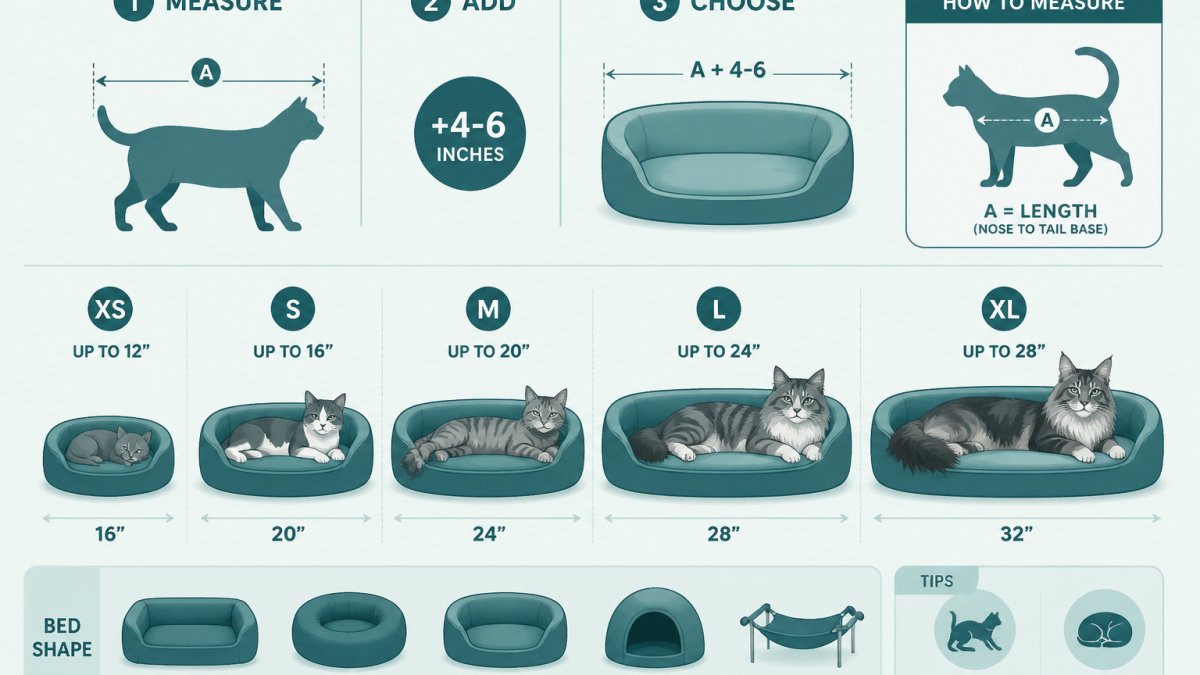
Measuring your cat takes only a few minutes and gives you the numbers you need to compare beds. Start by gently measuring your cat while it is relaxed and sleeping in its usual position. Use a soft measuring tape and record:
- Length: from the tip of the nose to the base of the tail, with the cat stretched out
- Curled width: the widest point of your cat while curled into a loaf or ball
- Stretched width: the width of your cat lying on its side, legs extended
Add a few inches to each measurement to leave room for comfortable movement. A cat that sleeps curled up still needs space to shift position, and a bed that is only as large as the cat's body can feel cramped.
If your cat will not hold still, observe its favorite sleeping spots and estimate from those. The most useful measurement is how much space your cat already chooses to occupy.
Cat Bed Size Chart by Cat Size and Sleeping Style
Use the chart below as a starting point. Sizes are approximate, and the best choice depends on your cat's sleeping habits as well as its weight.
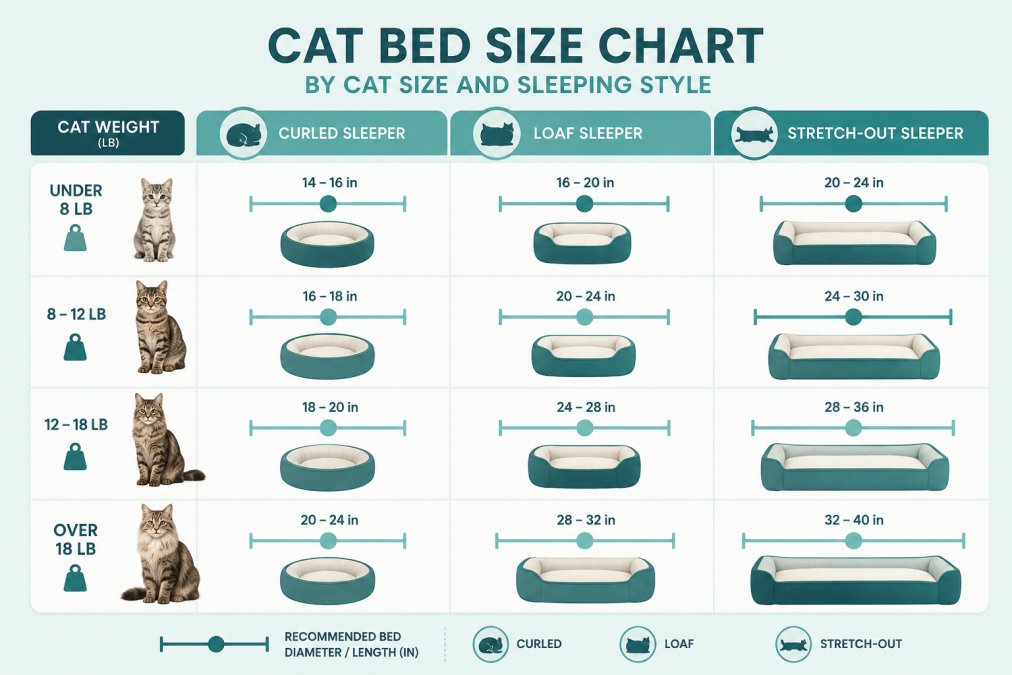
| Cat Weight | Curled Sleeper | Loaf Sleeper | Stretch-Out Sleeper |
|---|---|---|---|
| Under 8 lb | 14 to 16 in | 16 to 18 in | 20 to 22 in |
| 8 to 12 lb | 16 to 18 in | 18 to 20 in | 22 to 24 in |
| 12 to 18 lb | 18 to 22 in | 20 to 24 in | 24 to 28 in |
| Over 18 lb | 22 to 26 in | 24 to 28 in | 28 to 32 in |
Curled sleepers tuck into a tight ball and do well in deeper, enclosed beds. Loaf sleepers sit with their paws tucked underneath and prefer a bed with a little more width. Stretch-out sleepers need the most length and are better suited to open or bolster-style beds.
Keep in mind that a cat's age, health, and personal habits can shift these numbers. Watch how your cat sleeps for a few days before you commit to a size.
Choosing a Bed for Large Cats
Large and heavy cats need beds that are both roomy and sturdy. A bed that is too lightweight can shift or flatten under a cat's weight, which makes it less comfortable and harder to keep in place. Look for a thick, firm base and a generous interior, and check that the bed can handle your cat's full weight without sagging. You can browse a double-layer scratcher sofa bed sized for big cats with a roomy TV-shaped sleeping surface.
Multi-cat households and cats that love to stretch out will often benefit from extra-long options. Larger cats often benefit from beds with broader sleeping surfaces, so compare the listed dimensions carefully before you choose.
If your cat is large and enjoys climbing, a sturdy raised bed with a wide base can also be a good fit. Make sure the height is comfortable for your cat to get in and out of, especially if it is older or has joint stiffness.
Choosing a Bed for Kittens and Growing Cats
Kittens grow quickly, so a bed that fits well now may be too small within a few months. Many owners choose a modest-sized bed for a young kitten and then upgrade as the cat reaches adulthood, which usually happens around the first year. Watching your kitten's growth and adjusting the bed size accordingly keeps it comfortable throughout its development.
Senior cats have different needs. Older cats may find it harder to climb into high-sided beds, and they often sleep more. A bed with lower entry points and cushioned support can make resting easier. Older cats often do better with beds that have lower entry points and cushioned support.
For cats with limited mobility, pet steps can help them reach a raised bed without strain. Pet steps can help cats with limited mobility reach a raised bed without strain.
Booking Your Next Step: Find Your Cat's Perfect Bed at Knead and Nuzzle
Now that you know how to measure your cat and which size suits its sleeping style, you are ready to shop with confidence. Start with your cat's measurements, compare the listed dimensions carefully, and choose a bed that gives your cat room to settle in. Knead and Nuzzle offers cat beds and furniture for cats at every stage of life, so you can find a comfortable place for your cat to rest.
Frequently Asked Questions
How do I know what size cat bed to buy? Measure your cat's length and curled width, add a few inches for comfort, and compare those numbers to the bed's interior dimensions. Consider how your cat usually sleeps, since curled and stretch-out sleepers need different shapes.
Should I buy a bed bigger than my cat? A slightly larger bed is usually better, because cats need room to shift position. A bed that is much too large may not feel secure to some cats, so aim for a snug but comfortable fit.
Do kittens need a different size bed? Yes. Kittens grow quickly, so a bed sized for a young kitten may need replacing within a few months. Plan to upgrade as your cat reaches adulthood.
Frequently Asked Questions
How do I measure my cat for a bed?
Measure your cat while it is relaxed and stretched out on its side. Record the length from nose to the base of the tail, and the width across the body at its widest point, usually the shoulders or hips. Add 4 to 6 inches to the length and 3 to 4 inches to the width so the cat can turn around, stretch and shift position comfortably. If your cat sleeps curled up, measure its curled length as well and use the larger of the two results as your target. Keep the tape flat against the fur rather than pressing into it, and take each measurement twice to confirm it.
How big should a cat bed be?
Most adult cats do well with a bed roughly 18 to 24 inches across, but the right size depends on your cat's body length and sleeping habits. A cat that curls tightly can rest in a smaller bed, while a cat that stretches out needs more room, often 24 inches or wider. Use your cat's measured stretched length as a baseline and add a few inches of margin. A bed that is too small forces the cat to sleep hunched, while a bed that is too large may feel insecure to some cats, so aim for a snug but comfortable fit.
Should a cat bed be bigger than the cat?
Yes, a cat bed should be somewhat larger than the cat so it can stretch, turn and change positions without feeling cramped. A common guideline is to allow 4 to 6 inches of extra length beyond the stretched body. Some cats prefer a bed that is only slightly bigger, because a snug space feels more secure. Watch how your cat settles in: if it rests with its body pressed against the rim, the bed may be too small, and if it ignores the bed entirely, it may be too large or too open.
What size bed does a large cat need?
Large cats, including many Maine Coons and other heavier breeds, usually need a bed of 24 to 30 inches in length or more, with a sturdy base that will not sag under their weight. Measure the stretched length and add a margin for turning and shifting. Look for beds with reinforced edges or a firm cushion that keeps the cat's weight supported. For very large cats, an oversized bed or a padded bench-style option often works better than a standard round bed.
How do I choose a bed for a kitten?
Kittens grow quickly, so choose a bed that fits their current size with room to grow, or plan to upgrade within several months. A bed around 14 to 18 inches works for most young kittens, but a larger bed may suit a kitten who is already sizable for its age. Low sides make it easier for a kitten to climb in and out, and a warm, enclosed design can help a young cat feel secure. Replace or resize the bed as the kitten approaches adult size, which typically happens between 9 and 12 months.
Do cats prefer small or large beds?
Cats vary in what they prefer. Some favor small, enclosed spaces where they can curl tightly and feel protected, while others prefer open beds where they can sprawl. Observe your cat's sleeping habits for a week or two before deciding. A cat that always curls up may do best in a compact bed, and a cat that stretches or lies on its side may need a larger surface. Offering one bed of each style is a practical way to find out which your cat chooses.
How much room should a cat have in a bed?
A cat should have enough room to lie down fully, stretch its front legs and turn around without touching the sides. In practice this means leaving a margin of several inches beyond the stretched body on each side. Avoid beds so large that the cat cannot feel its surroundings, since many cats prefer a little enclosure. Check the fit by watching your cat in the bed: it should settle in comfortably without its head or tail hanging over the edge.