 comparison
Are Premium Cat Toys Worth It? A Value Analysis
Table of Contents
- What Makes a Cat Toy Premium
- Best Interactive Toys for Indoor Cats and Their Real Value
- Durable Cat Toys: How Lifespan Affects Cost Per Use
- Safe Cat Toys: What Premium Materials Actually Protect Against
- Premium vs. Budget Cat Toys: Where You Actually Save Money
- How to Match Toys to Your Cat's Play Style and Preferences
- The Real Answer: Are Premium Cat Toys Worth It?
- Frequently Asked Questions
Last Updated: October 13, 2026
What Makes a Cat Toy Premium
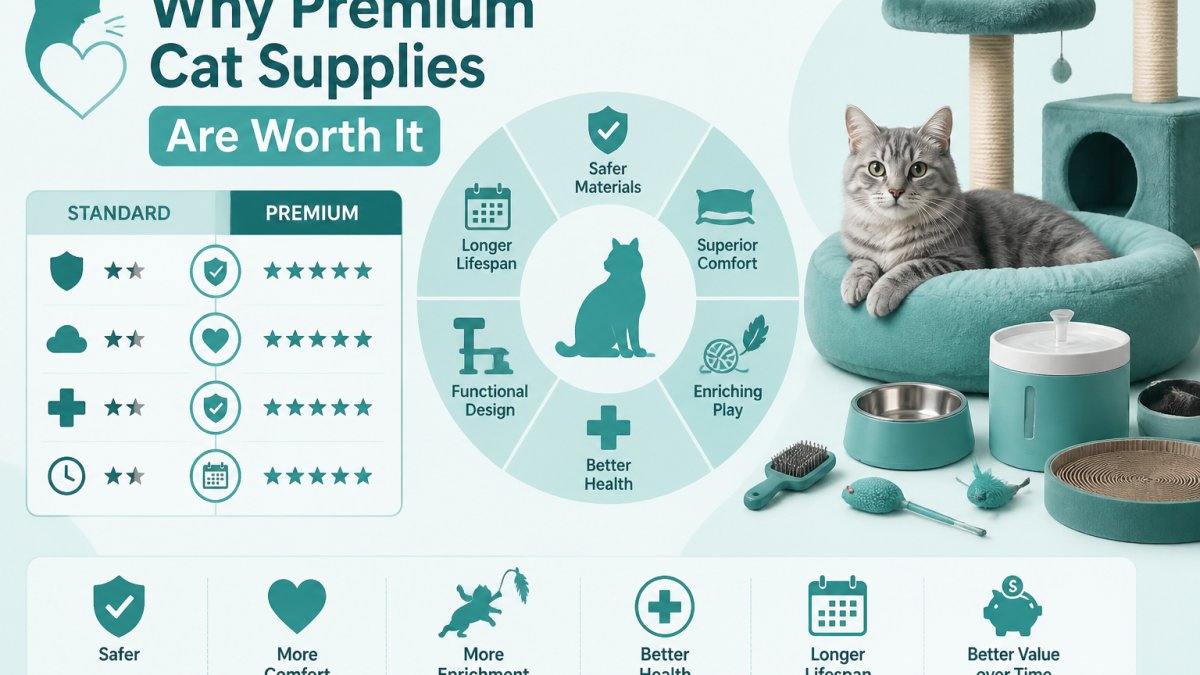
Premium cat toys differ from budget alternatives in materials, safety standards, and durability testing. Premium toys typically use non-toxic materials, reinforced stitching, and interactive elements designed to hold a cat's attention for months rather than weeks.
Premium toys often feature shred-resistant materials, replaceable components, and designs based on feline behavior research.
Safety certifications matter too. Many premium cat toys meet stricter material standards, use secure attachments that won't detach, and avoid small parts that pose choking hazards, fewer recalls and less worry about toxic dyes or harmful adhesives.
Best Interactive Toys for Indoor Cats and Their Real Value
Interactive toys keep indoor cats mentally stimulated and physically active.
Feather wand toys drive hunting instincts and give cats a sense of prey capture. Quality versions have reinforced handles and secure feather attachments that survive weeks of vigorous batting; budget versions lose feathers within days.
Puzzle toys and treat-dispensing balls require cats to problem-solve. Premium versions have multiple difficulty levels and durable mechanisms that don't jam, providing mental enrichment simple toys cannot match.
Track toys (circular toys with a ball rolling inside) appeal to cats that prefer independent play.
Durable Cat Toys: How Lifespan Affects Cost Per Use
Durability is the biggest lever on whether a premium toy pays for itself, but "durable" is meaningless without specifics. Here's what to look at, how to test it, and how to run the math.
What Durability Looks Like in Practice
Durability is several properties, and they fail at different rates:
- Attachment integrity. On wand toys, the joint between string and lure fails first. Premium versions use a swivel clip or a double-knotted, glued, and stitched connection; budget versions rely on a single knot that works loose within days.
- Fabric and feather resilience. Natural feathers shred and mat; synthetic feathers snap at the quill. Look for feathers stitched or glued along the full quill, and tight-weave fabrics that resist pilling.
- Mechanism reliability. On puzzle feeders and track toys, moving parts are the weak link. Premium puzzle toys use smooth-glide chambers and removable, washable inserts; budget versions use press-fit plastic that warps and jams.
- Track and ball geometry. Cheap plastic develops flat spots and the ball catches at seams. Premium tracks use a continuous molded channel and a weighted ball that keeps rolling for months.
- Coating and dye stability. Cheap dyes bleed when a cat drools on them; cheap coatings flake. Premium toys use colorfast, saliva-resistant finishes.
A Simple Home Durability Test
You don't need a lab. Before committing to a category:
- The tug test. Pull the attachment firmly for 10 seconds. If stitching stretches, glue separates, or the knot slips, it will fail under real play.
- The wash test. Hand-wash a new toy once. If dye runs, seams pucker, or plastic parts deform, it won't survive routine cleaning.
- The drop test. Drop the toy from waist height onto a hard floor five times. Bells, beads, and small attachments that pop off are a choking hazard and a durability red flag.
- The two-week log. Note the date you introduce each toy and the date it stops working as intended. A month of this gives you real data on your cat's play intensity and replacement rate.
Running the Cost-Per-Month Math
The formula is simple: purchase price ÷ months of usable life = cost per month of use.
Worked examples (your numbers will vary):
- A budget wand that lasts two weeks of daily play requires frequent replacements throughout the year. Even at a very low unit price, the annual spend adds up fast.
- A premium wand that lasts three months of daily play requires fewer replacements a year. The annual spend is often comparable or lower, and you spend far less time replacing toys.
- A budget puzzle feeder that jams after a few weeks versus a premium feeder with washable, replaceable inserts that runs six months or more. The premium feeder's cost per month is frequently lower once you account for replacements you don't buy.
The crossover point depends on two variables: how hard your cat plays and how long the toy survives. A cat that plays gently may never justify premium pricing; a cat that plays daily and destroys toys usually will within the first year.
Tracking Your Own Numbers
Keep a simple log for one month: toy name and category, date introduced, date it stopped working as intended, purchase price, and approximate minutes of play per day. At month's end, divide total spend by total play sessions. That's your real cost per play session, the number that tells you whether premium is worth it. Most owners are surprised by how much "cheap" toys cost once replacement frequency is factored in.
Safe Cat Toys: What Premium Materials Actually Protect Against
Material safety is where premium toys justify their cost most clearly. Budget toys sometimes use dyes that aren't certified non-toxic, adhesives that degrade with saliva, or materials that splinter when chewed.
Small parts represent a real risk. Budget toys sometimes have bells, beads, or attachments that detach easily. Cats swallow these, creating vet emergencies.
Material durability also affects safety. A toy that shreds releases fibers a cat might ingest, and sharp edges after breaking pose injury risks. Premium materials resist shredding, and premium toys are designed to break cleanly if they fail at all.
According to ASPCA guidelines on pet safety, common toy hazards include detachable small parts, toxic dyes, and materials that splinter. Premium toys engineered to avoid these hazards reduce vet visits and stress.
Premium vs. Budget Cat Toys: Where You Actually Save Money
Most articles on this topic either recommend premium toys or budget toys. Very few define what "premium" actually means or give you a framework for deciding whether the upgrade pays off for your cat.
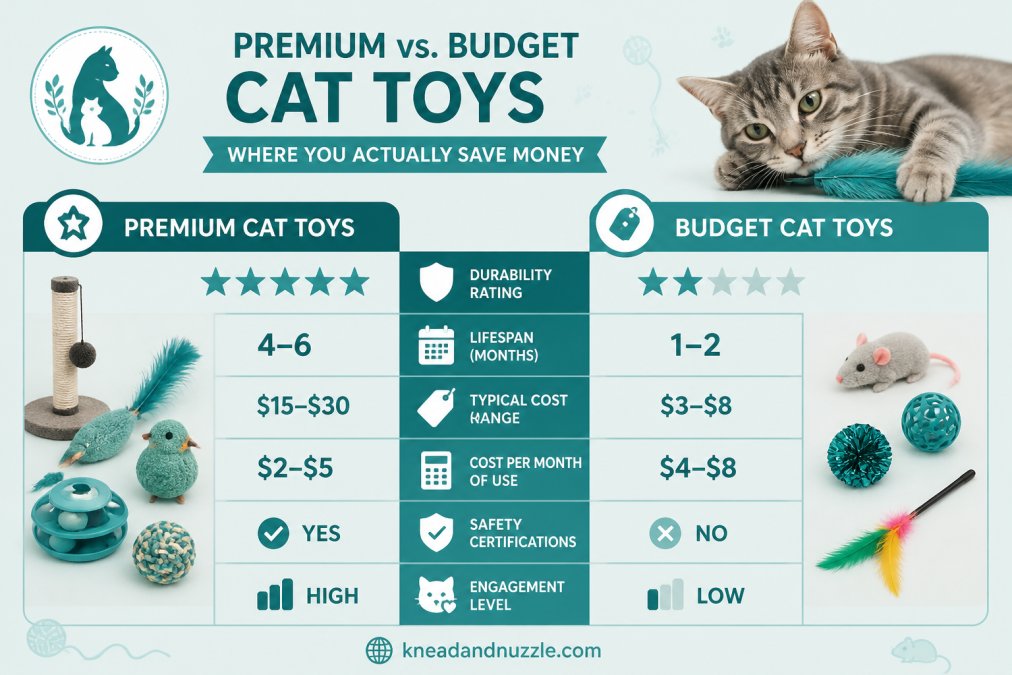
What Actually Makes a Toy Premium
Price is a proxy, not a definition. A toy is genuinely premium when it clears several of these criteria at once:
- Material transparency. The manufacturer names the materials (for example, "food-grade silicone," "natural rubber," "OEKO-TEX certified felt") rather than using vague terms like "soft fabric." If you can't find out what's in it, it isn't premium.
- Construction method. Reinforced stitching at stress points, riveted or double-knotted attachments, and seams that don't rely on a single line of thread. Budget toys typically use a single stitch line and glue-only joints.
- Repairability. Replacement feathers, wands, balls, or springs sold separately. A toy you can refresh is worth more than a toy you replace.
- Safety testing. Third-party testing for lead, phthalates, and heavy metals in dyes and coatings. Look for a named testing standard or a lab report, not just a "pet safe" badge.
- Design intent. Shapes and mechanisms based on feline hunting or foraging behavior, erratic wand motion, variable-difficulty puzzle chambers, weighted bases, rather than generic shapes with a bell attached.
- Warranty or satisfaction policy. A brand willing to stand behind a toy for 30+ days is signaling something about how it expects the toy to hold up.
A toy that hits four or more of these is premium in practice, regardless of what it costs. A toy that hits one or two is not, even if the price tag says otherwise.
The Value Framework
Instead of asking "is premium worth it," ask three questions:
- How often does my cat actually play with this toy? A toy used daily for 10 minutes does 60x the work of one used weekly.
- How long does it survive that level of play? This is the durability question.
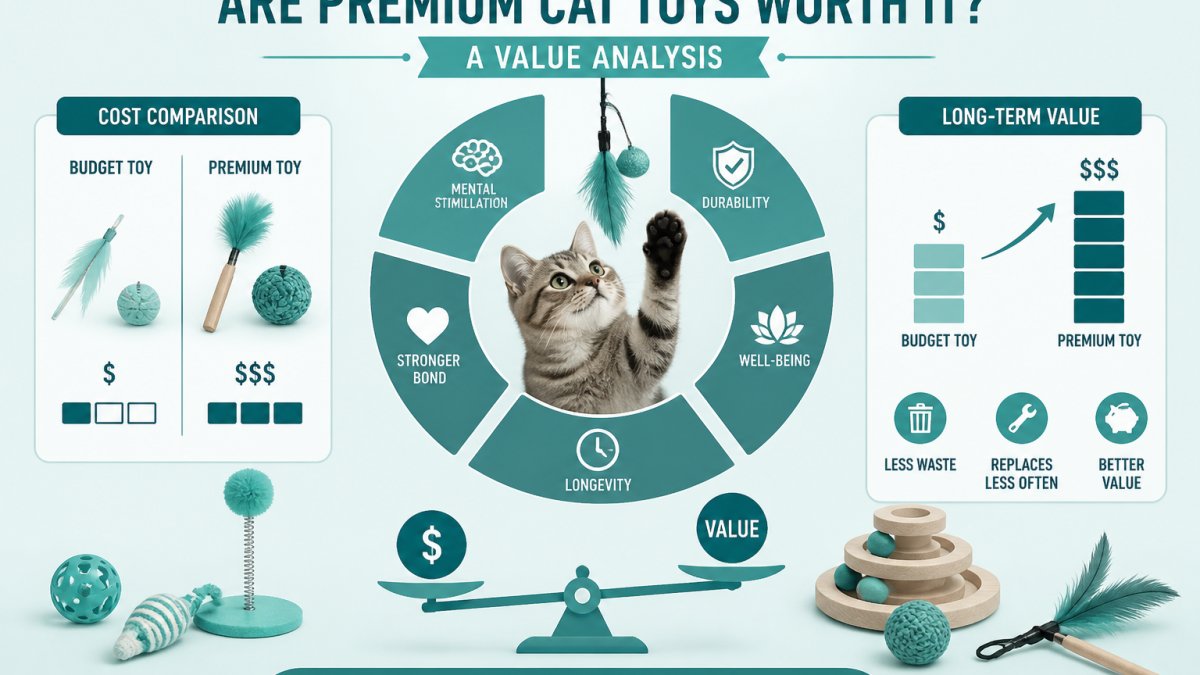
- What does it cost me per month of real use? Divide purchase price by months of usable life. That number, not the sticker price, is the honest comparison.
Where the Savings Actually Show Up
Premium toys tend to win on three cost lines that budget toys hide:
- Replacement frequency. A budget wand that sheds its attachment in two weeks means roughly 26 purchases a year if your cat plays daily. A premium wand that lasts three months means four. The premium toy can cost several times more per unit and still come out ahead.
- Time cost. Every replacement is a shopping trip, a shipping wait, and a reintroduction period while your cat re-learns the toy. That's real overhead, especially in multi-cat homes.
- Waste. Discarded toys, packaging, and shipping materials add up. Fewer replacements means a smaller footprint.
Budget toys still win in specific cases: a cat that plays casually, a single-cat household, or a toy category you're testing for the first time. Buying budget to see whether your cat even likes wand toys is smart; buying budget for a toy you know your cat loves is usually false economy.
How to Match Toys to Your Cat's Play Style and Preferences
Not all cats play the same way. Matching toy type to play style determines whether your cat actually uses the toy.
Cats that seek human interaction thrive with wand toys and laser pointers, which require your participation.
Cats that hunt independently prefer track toys, balls, and toys they can bat around alone.
Cats drawn to puzzle-solving engage with treat-dispensing toys and interactive feeders.
Observation reveals preference patterns. Watch your cat for a week. Does she pounce on moving objects? Seek human play? Investigate small spaces?
The Real Answer: Are Premium Cat Toys Worth It?
Premium cat toys worth the investment deliver value when your cat actually uses them and when you calculate total cost over time.
Premium toys reduce replacement frequency, cut environmental waste, and provide peace of mind about material safety.
Budget toys work for casual players and single-cat households with modest budgets.
The decision hinges on three factors: your cat's play intensity, your budget tolerance, and how much time you want to spend replacing broken toys.
The choice between premium and budget cat toys isn't black-and-white.
Frequently Asked Questions
Do expensive cat toys last longer than budget options?
Premium cat toys typically use higher-quality materials and construction methods that withstand regular play longer. Budget toys often show wear within weeks, while premium options may last months or years. The difference in lifespan directly affects cost per use, a toy that lasts six months costs significantly less per play session than one lasting only a few weeks, even if the upfront price is higher.
Which interactive toys are best for indoor cats that get bored easily?
Indoor cats benefit from toys that stimulate their hunting instinct and provide mental engagement. Wand toys with feather or prey-like attachments, puzzle toys that dispense treats, and track toys that allow independent play work well for most cats. The best choice depends on your cat's play style, some prefer active interactive sessions, while others engage independently with electronic toys or puzzle feeders that challenge their problem-solving skills.
How can you tell if a cat toy is safe?
Safe cat toys have secure seams, no small detachable parts that pose choking hazards, and non-toxic materials. Check that feathers or strings are firmly attached and won't unravel. Avoid toys with loose beads, bells that can be chewed off, or materials containing harmful dyes. Premium toys typically meet stricter safety standards and use materials tested for pet safety, while budget toys may lack these safeguards.
Are premium cat toys worth buying if my cat ignores most toys?
If your cat has ignored toys in the past, the issue is usually play style mismatch rather than toy quality. Spend time observing what movements, textures, or interactions your cat responds to before investing in premium options. Once you identify their preferences, whether they prefer wand toys, puzzle toys, or track toys, premium versions of that specific type are more likely to hold their attention and provide lasting value than buying multiple ignored options.