 blog
blog
Best Interactive Toys for Indoor Cats: 2026 Guide
Table of Contents
- Quick Comparison: Interactive Cat Toys at a Glance
- Why Indoor Cats Need Interactive Cat Toys
- Automatic Cat Toys for Solo Play
- Puzzle Feeders for Cats: Mental Stimulation That Works
- How to Keep Indoor Cats Active With Manual Play
- Matching Toys to Your Cat's Age and Personality
- Safety, Noise, and Durability: What to Check Before You Buy
- Conclusion
- Frequently Asked Questions
Last Updated: September 16, 2026
Quick Comparison: Interactive Cat Toys at a Glance
The best interactive toys for indoor cats fall into four categories: automatic electronic toys, puzzle feeders, manual wand toys, and DIY enrichment setups. Each targets a different part of your cat's hunting sequence, and most indoor cats do best with a mix of all four rather than relying on any single type.
| Toy Type | Best For | Engagement Style | Supervision Needed |
|---|---|---|---|
| Motion-activated electronic | Busy owners, solo play | Independent | Low |
| Puzzle feeders | Mental stimulation, slow eaters | Solitary | Low |
| Wand and feather teasers | Bonding, exercise | Interactive | Required |
| Cat tunnels and activity boards | Hiding, stalking, ambush play | Independent | Low |
Why Indoor Cats Need Interactive Cat Toys
Indoor cats live longer, safer lives than outdoor cats, but they trade physical activity for that safety. A sedentary indoor lifestyle contributes to weight gain, and boredom shows up as destructive scratching, overgrooming, or 3 a.m. sprinting sessions.
Automatic Cat Toys for Solo Play
Automatic cat toys for solo play are the practical answer for owners who work long hours or travel. These toys run on their own, giving your cat independent play sessions without you holding a wand for 20 minutes. But "automatic" covers a wide range, and the differences between a $12 wobble ball and a $60 app-controlled laser matter more than most listicles admit.
Motion-Activated and Electronic Options
Motion-activated toys trigger when your cat approaches, which mimics unpredictable prey movement. The mechanism matters: infrared (IR) sensors detect body heat and motion within a cone, while pressure or vibration sensors react only when your cat physically contacts the toy. IR toys tend to feel more "alive" because they fire before contact, but they also false-trigger on sunlight and warm surfaces.
- Run time per charge: 2-4 hours of intermittent use is typical for a quality rechargeable unit
- Charge time: under 3 hours is reasonable; anything over 6 hours is a friction point
- Replacement parts: feather attachments, wand tips, and laser modules should be user-replaceable
Noise Level: The Factor Most Guides Skip
Many electronic toys are louder than the product photos suggest. A motorized wand or rolling ball can hum at a pitch that spooks a noise-sensitive cat long before it engages. If your cat startles at the vacuum or hides from the doorbell, treat noise as a primary filter, not an afterthought.
Smart-Home and App-Controlled Toys
A newer category of automatic toys connects to Wi-Fi or Bluetooth and lets you schedule play sessions, adjust speed, or trigger a session remotely from a phone. For owners who are away during the day, this is the closest thing to being home at 3 p.m. when a cat's energy peaks.
What to weigh before buying into the category:
- App dependency: If the app is discontinued, does the toy still run on its default cycle?
- Scheduling granularity: Can you set multiple short sessions rather than one long one?
- Local control: Does it work over your home network, or does it require a cloud connection to function at all?
Battery Life and Automatic Shut-Off
Automatic shut-off is non-negotiable. A toy that runs continuously becomes background noise your cat ignores within days, and it drains the battery. Most quality motion-activated toys cycle for 10-15 minutes, then rest.
Check three things before buying:
- Rechargeable vs. disposable batteries: Rechargeable wins for daily use
- Automatic shut-off timer: 10-15 minutes is the useful range
- Noise level: A loud motor defeats the purpose for sound-sensitive cats
Puzzle Feeders for Cats: Mental Stimulation That Works
Puzzle feeders for cats turn mealtime into a problem-solving task. Instead of eating from a bowl in 90 seconds, your cat works for each kibble, which delivers mental stimulation and slows fast eaters.
Treat-Dispensing Toys and Food Puzzles
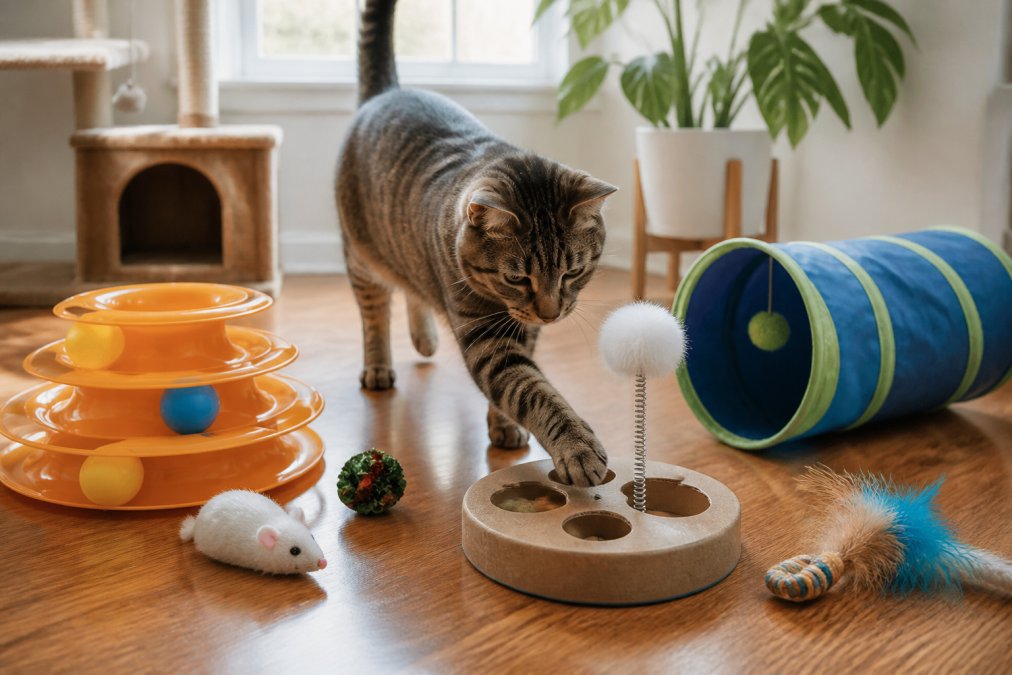
Treat-dispensing toys range from simple wobble balls that release kibble when batted, to multi-level activity boards that require pawing, nudging, and flipping. Start with an easy wobble ball for a cat new to puzzles, then graduate to a more complex activity board once they've mastered the mechanics.
How to Keep Indoor Cats Active With Manual Play
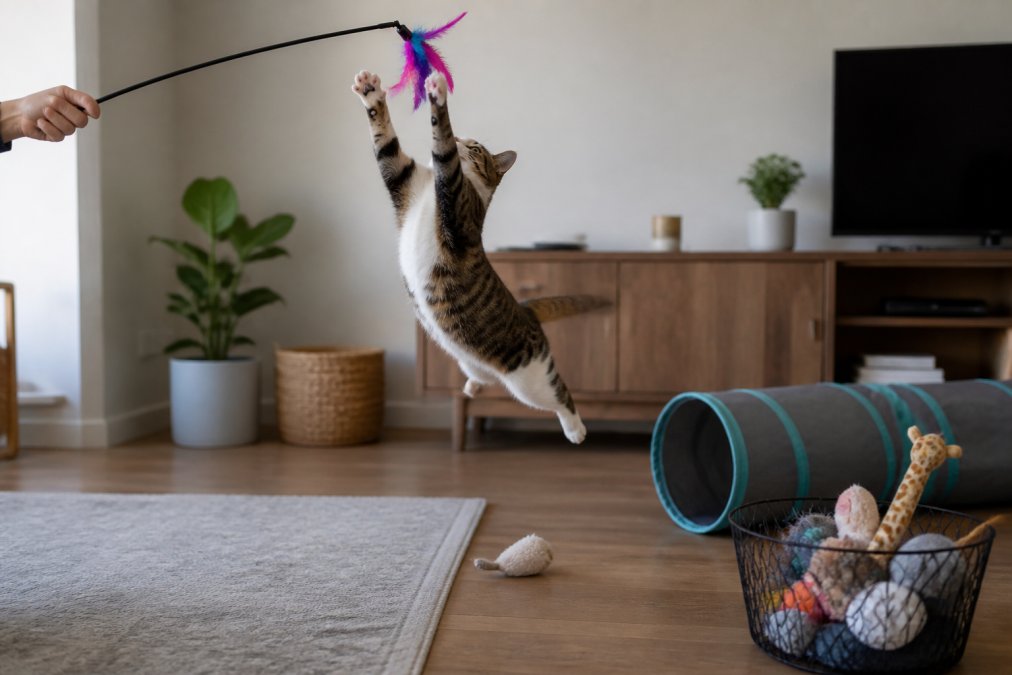
How to keep indoor cats active comes down to one habit: short, frequent interactive sessions that mimic a real hunt. Two 10-minute wand sessions a day does more for your cat's fitness than an hour of scattered solo play.
Matching Toys to Your Cat's Age and Personality
Age and personality decide which toys work, and most generic guides skip this entirely. A kitten needs different enrichment than a senior cat, a high-drive hunter needs different stimulation than a laid-back napper, and an aggressive chewer needs different materials than a gentle mouth. This section segments by life stage and temperament so you can skip the trial-and-error.
Kittens (Under 1 Year)
Kittens are building motor skills and social boundaries. Wand toys with lightweight feathers or fabric strips let them practice the stalk-pounce-catch sequence without overexerting growing joints. Keep sessions short (5-10 minutes) and frequent, because kitten attention spans are brief.
Active Adults (1-7 Years)
Adult cats with high prey drive need toys that move unpredictably. Motion-activated electronic toys, laser pointers (always ended with a physical catch), and multi-level activity boards work well here. Two 10-minute wand sessions a day plus one puzzle feeder meal is a common baseline that most owners find sustainable.
Seniors (7+ Years)
Senior cats often have reduced mobility, arthritis, or vision changes. Gentle wand play at floor level, easy puzzle feeders with large kibble openings, and soft, lightweight toys they can bat without jumping are the better fit. Watch for signs of discomfort (hesitation before pouncing, stiffness after play) and shorten sessions accordingly.
Shy, Anxious, or Noise-Sensitive Cats
For cats who startle easily, the toy's sound profile matters as much as its motion. Quiet puzzle feeders, fabric tunnels for hide-and-seek, and slow-moving wand play build confidence without triggering a flight response. Introduce new toys at a distance and let the cat approach on its own schedule.
Aggressive Chewers and Destructive Cats
This is the profile most guides ignore, and it's the one that costs owners the most in replacements. Cats who bite through wand attachments, gnaw on plastic housings, or shred fabric toys need materials rated for heavy use.
What holds up:
- Reinforced stitching on plush and fabric toys, with no glued-on components
- Durable rubber or silicone for chew-friendly toys, free of small detachable pieces
- Solid housings on electronic toys, ideally with recessed screws rather than snap-fit seams
A Quick Reference
| Cat Profile | Best Toy Types | Avoid |
|---|---|---|
| Kittens (under 1 year) | Wand toys, soft balls, tunnels | Small parts, loose strings |
| Active adults | Motion-activated, laser pointers, activity boards | Static toys |
| Seniors | Gentle wand play, easy puzzle feeders | High-intensity electronic toys |
| Shy or anxious cats | Tunnels, hide-and-seek, quiet puzzles | Loud motorized toys |
| Aggressive chewers | Durable rubber, reinforced plush | Thin fabric, glued-on parts |
Safety, Noise, and Durability: What to Check Before You Buy
Safety, noise, and durability are the three factors that separate a toy your cat uses for years from one that breaks or gets ignored in a week. Check all three before you buy.
Conclusion
Building a play routine that actually works takes more than buying one flashy toy. It takes matching the right tools to your cat's age, energy, and personality, then rotating them to keep engagement high.
Frequently Asked Questions
What are some good active toys for indoor cats?
Motion-activated wands, laser pointers with automatic shut-off, feather teasers, and wobble balls all trigger a cat's hunting instinct. For independent play, rechargeable electronic toys that move on their own work well. Puzzle feeders add mental stimulation by making cats work for treats. Rotate three to four toys at a time and swap them weekly so novelty stays high. Supervised play with a wand remains the most effective way to burn energy in a short session.
Are automatic laser toys safe for cats?
Automatic laser toys are safe when they include an automatic shut-off timer, usually after 10 to 15 minutes. The bigger concern is frustration: because a laser never gets caught, some cats become anxious. Pair laser sessions with a physical toy like a feather teaser or treat-dispensing ball so your cat ends the session with a win. Never point a laser directly into your cat's eyes, and avoid leaving the unit running unattended for long periods.
How often should I rotate my cat's toys?
Rotate toys every three to five days. Keep three or four toys out at once and store the rest out of sight. When a toy returns after a week away, it reads as new again, which restores interest without spending more money. This matters most for automatic cat toys for solo play, since cats habituate to predictable movement quickly. Wash fabric toys and check battery compartments during each rotation.
How do puzzle feeders help keep indoor cats active?
Puzzle feeders for cats turn a meal into a foraging task, which mimics the hunting instinct cats would use outdoors. Instead of eating from a bowl in two minutes, your cat nudges, paws, and rolls a feeder for 10 to 15 minutes. That extra movement supports physical exercise and cognitive development, and it gives busy owners a way to add enrichment without being in the room. Start with an easy wobble ball, then move to a multi-level activity board as your cat learns.